Green Power Free Market Heats Up: Corporate Challenge Shifts from Price to
Richten Energy 52
1. Share of Renewable Electricity Entering the Open Market Continues to Rise, with SME Participation and Purchases Increasing
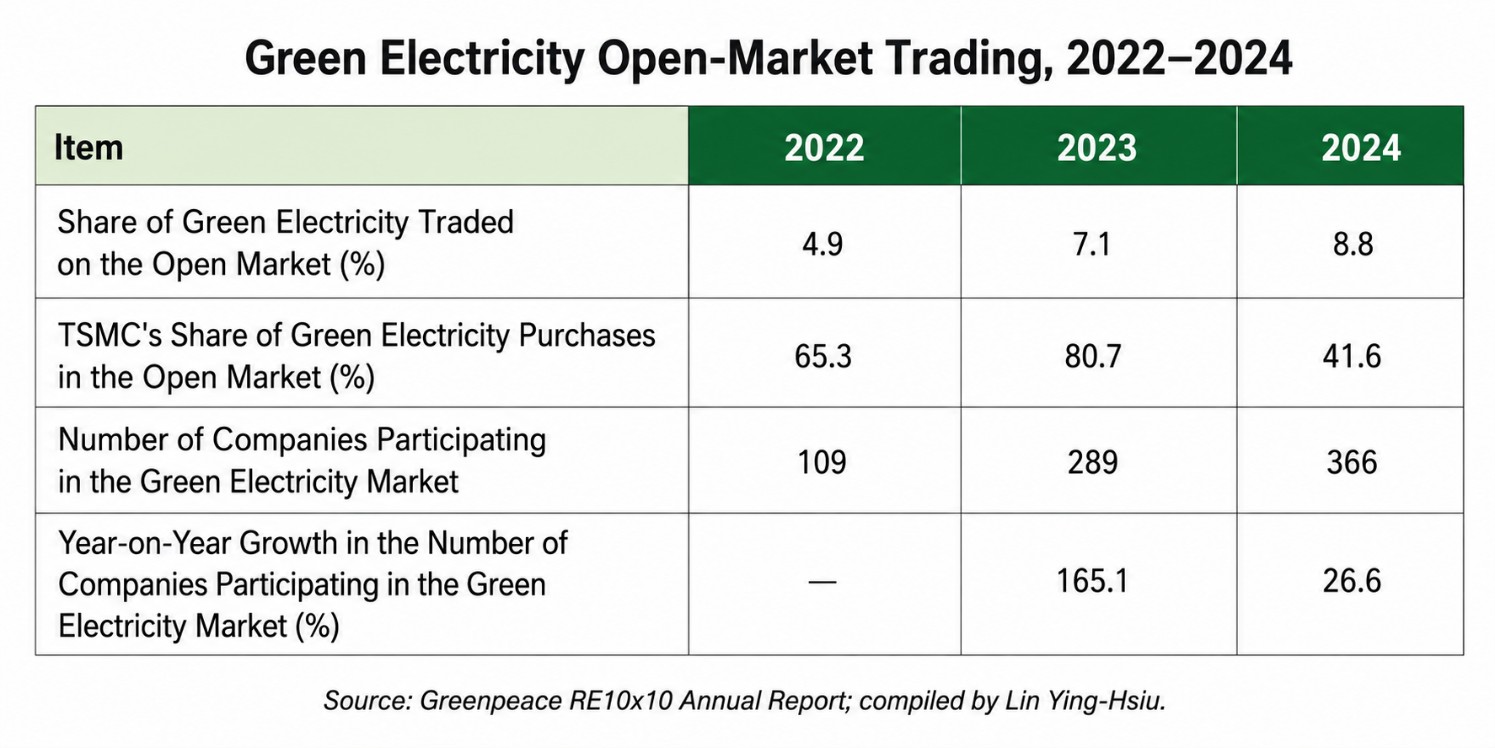
Compared with 2022, when only around 4.9% of renewable electricity entered the open market, the proportion had risen steadily to 8.8% by 2024. This suggests that, as feed-in tariffs continue to decline, the market is gradually moving away from a situation in which Taiwan Power Company (Taipower) dominates renewable electricity purchases. Although Taiwan Semiconductor Manufacturing Company (TSMC) remains the largest buyer, accounting for 41.6% of the open renewable electricity market, its share has fallen by nearly half from 2023.
Notably, the five largest renewable electricity buyers in 2024 — TSMC, United Microelectronics Corporation (UMC), AU Optronics Corp. (AUO), Micron Technology Taiwan and Delta Electronics — still accounted for 51.8% of the open market. However, purchases by small and medium-sized enterprises (SMEs) represented 4.3% of total renewable electricity transactions, a significant increase from 1.1% the previous year. At the same time, the number of companies using renewable electricity rose sharply from 109 in 2022 to 366 in 2024, indicating growth in both the number of SMEs purchasing renewable electricity and the volume they purchase.
2. Rising Electricity Tariffs Strengthen Incentives for Self-Consumption and Renewable Electricity Wheeling, but Wheeling Prices Reach New Highs
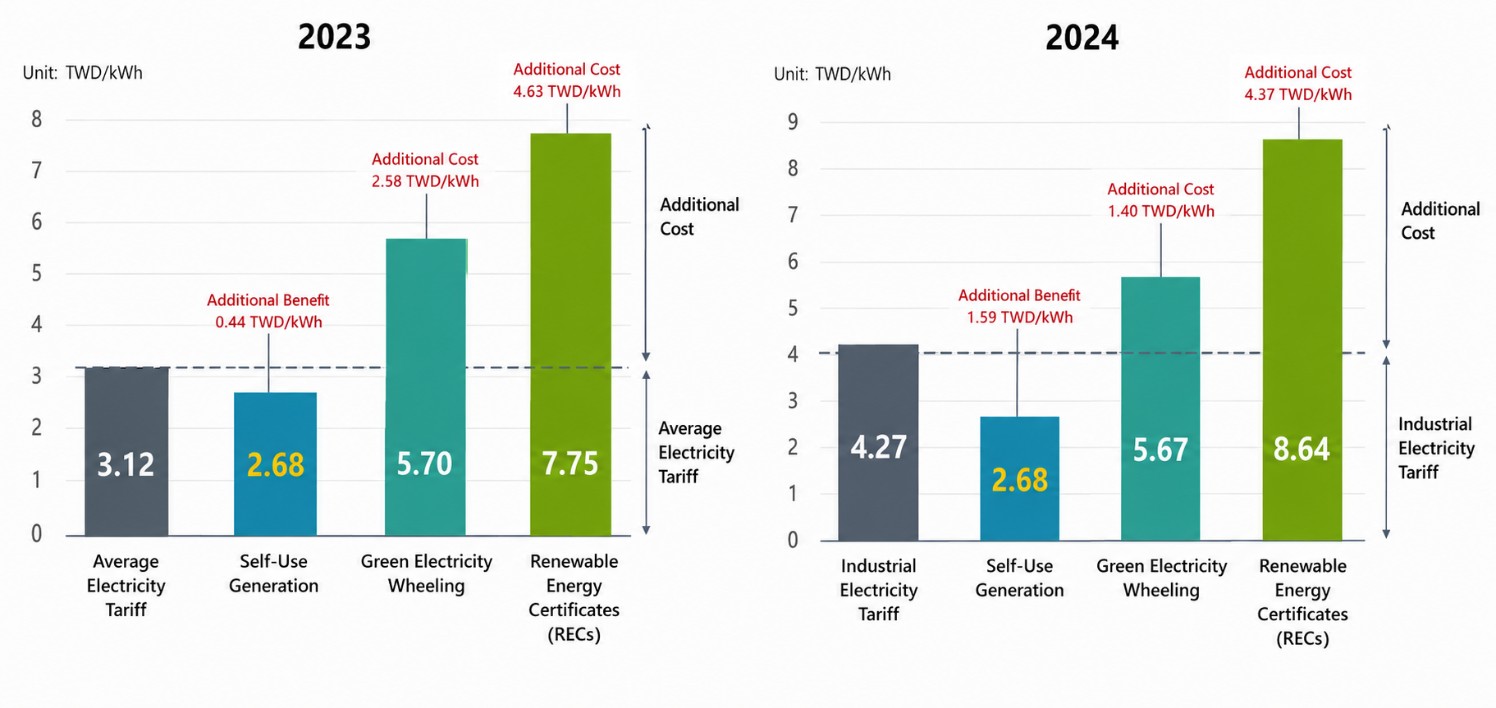
In 2024, renewable electricity wheeling remained the main route through which most companies obtained renewable electricity, accounting for 97% of procurement. The average price was approximately NT$5.67 per kWh, broadly unchanged from 2023. Wheeling contracts typically run for at least one year, helping companies reduce their exposure to future price fluctuations.
Following the electricity tariff increase in October 2024, the average industrial electricity tariff rose to NT$4.27 per kWh. Compared with 2023, the additional benefit of generating renewable electricity for on-site consumption also increased to NT$1.59 per kWh, narrowing the additional cost of renewable electricity wheeling from NT$2.58 to NT$1.40 per kWh. If electricity tariffs continue to rise, the cost advantage of using renewable electricity will become increasingly apparent.
In 2024, renewable electricity wheeling prices reached a new high of more than NT$6.60 per kWh. In addition, the share of transactions in the second-highest price range of NT$6.10–6.50 per kWh rose from 16.7% in 2023 to 22.6% in 2024. This suggests that companies purchasing smaller volumes of electricity are finding it increasingly difficult to secure favourable wheeling contracts and reasonable prices from electricity retailers, leaving them at a disadvantage in price negotiations.
Businesses: Prioritise Self-Consumption and Diversify Renewable Electricity Procurement
Greenpeace recommends that businesses prioritise investment in solar power systems for on-site generation and self-consumption. This not only provides access to lower-cost renewable electricity but also reduces reliance on the external grid, helping to stabilise long-term renewable electricity costs and supply. Greenpeace has similarly highlighted self-generation and self-consumption as a means of reducing companies' exposure to constrained renewable electricity supplies.
Businesses can also consider diversifying their renewable electricity procurement channels. Options include purchasing renewable electricity through trading platforms and electricity retailers, signing long-term power purchase agreements (PPAs) directly with renewable energy generators, and leasing third-party rooftops for renewable electricity generation and wheeling the electricity back for their own use. These approaches can help businesses overcome space constraints and achieve their renewable electricity targets.
Government: Provide Business Incentives and Safeguards and Build a Fair Renewable Electricity Market
Greenpeace is calling on the government to draw on international experience by introducing measures such as tax credits and low-interest loans to strengthen incentives for businesses to purchase and invest in renewable electricity while lowering initial capital barriers.
At the same time, supporting mechanisms for renewable electricity trading should be strengthened. These should include improving the management of surplus electricity so that businesses can use excess renewable electricity more flexibly; increasing flexibility in renewable electricity dispatch to prevent generated electricity from going unused; and accelerating reform of renewable electricity market mechanisms.
Such reforms could include improving transparency in bidding systems and establishing an open and transparent renewable electricity trading platform to increase market efficiency and ensure that SMEs have a fair opportunity to obtain renewable electricity rather than allowing supplies to be dominated by large corporations.
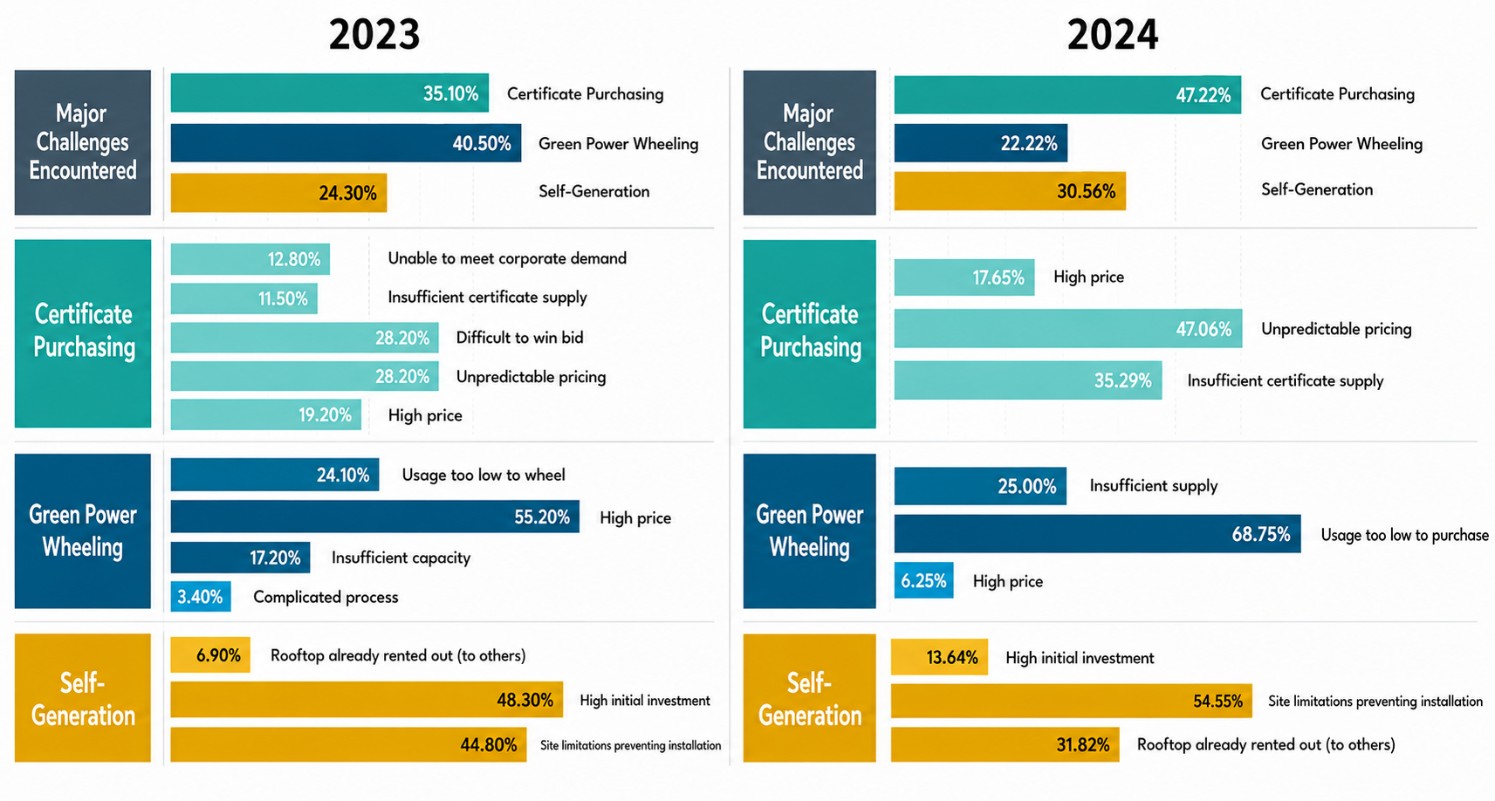
Taiwan's renewable electricity market accelerated markedly in 2024. The continued growth of the open market, the rising number of participating companies and the shift in corporate concerns from the price of renewable electricity towards how to secure supplies all point to an increasingly active market.
Looking ahead, new trading mechanisms — including Taipower's proposed tiered electricity pricing system, its small-volume renewable electricity sales programme, and the Ministry of Economic Affairs' continued promotion of its upgraded green electricity flexible-allocation sandbox scheme — are expected to further stimulate the renewable electricity market. Taipower and the Ministry of Economic Affairs have been developing new electricity products and allocation mechanisms aimed at giving businesses greater flexibility in obtaining renewable and lower-carbon electricity.
Businesses are therefore advised to begin planning their renewable electricity strategies early and take a proactive approach in order to secure an advantage in the transition.
News source: Environmental Information Center
(The share action will open in a new window.)