New Global ESG Trend: Corporate Façades Emerge as a New Scope 2 Asset
Richten Energy 0
CNA Business Information Service
As corporate decarbonisation ambitions return their focus to the location-based method, physical greenhouse gas inventories and hourly data, coloured solar façades are no longer simply an architectural aesthetic. They are becoming behind-the-meter energy infrastructure that can be measured, verified and incorporated into capital allocation and climate disclosures.
Renewable energy certificates have not lost their relevance. But on their own, they are no longer sufficient to answer the most important question facing corporate boards:
Has the company actually changed the way it uses energy, or has it merely changed the allocation of energy attributes on its carbon accounts?
On 11 June 2026, the Science Based Targets initiative (SBTi) formally released its Corporate Net-Zero Standard V2.0. Less than two months later, on 29 July, the GHG Protocol announced further moves to align corporate greenhouse gas accounting with ISO 14064-1, as part of a broader effort to establish a harmonised global corporate accounting standard and to clarify the treatment of physical emissions, market instruments and corporate actions.
International Scope 2 rules are moving beyond the pursuit of a single, lower emissions figure towards greater scrutiny of the energy activities, rights and investment evidence behind that figure.
This does not mean that power purchase agreements (PPAs), renewable electricity supply arrangements, energy attribute certificates or virtual PPAs have ceased to serve a purpose. On the contrary, it means these instruments need to return to their proper place: they are important tools in corporate energy transition strategies, but they are not the entire strategy.
Renewable energy certificates have not disappeared — they have moved from the destination back into the toolbox
Under SBTi V2.0, CNZS-C9.4 requires companies to determine their target ambition on the basis of the physical GHG inventory, including location-based Scope 2. The Standard also distinguishes market instruments and mitigation actions that are not reflected in the physical inventory, requiring such actions to be accounted for and reported separately.
The real significance of this change is not that the market-based method has been declared invalid. Rather, companies are being asked to distinguish clearly between different layers of information.
At a minimum, businesses need to manage three layers of evidence.
The first is the physical inventory: how much electricity the company consumes, how much it purchases from the local grid, and the average emissions profile of that grid.
The second is energy procurement and attributes: how the company secures and claims low-carbon electricity through PPAs, electricity supply agreements and energy attribute certificates.
The third is investment and implementation evidence: how much capital the company has invested in energy efficiency, on-site generation, energy storage and energy management; how much grid electricity demand those investments have actually reduced; and how they affect operating costs, risk and future cash flows.
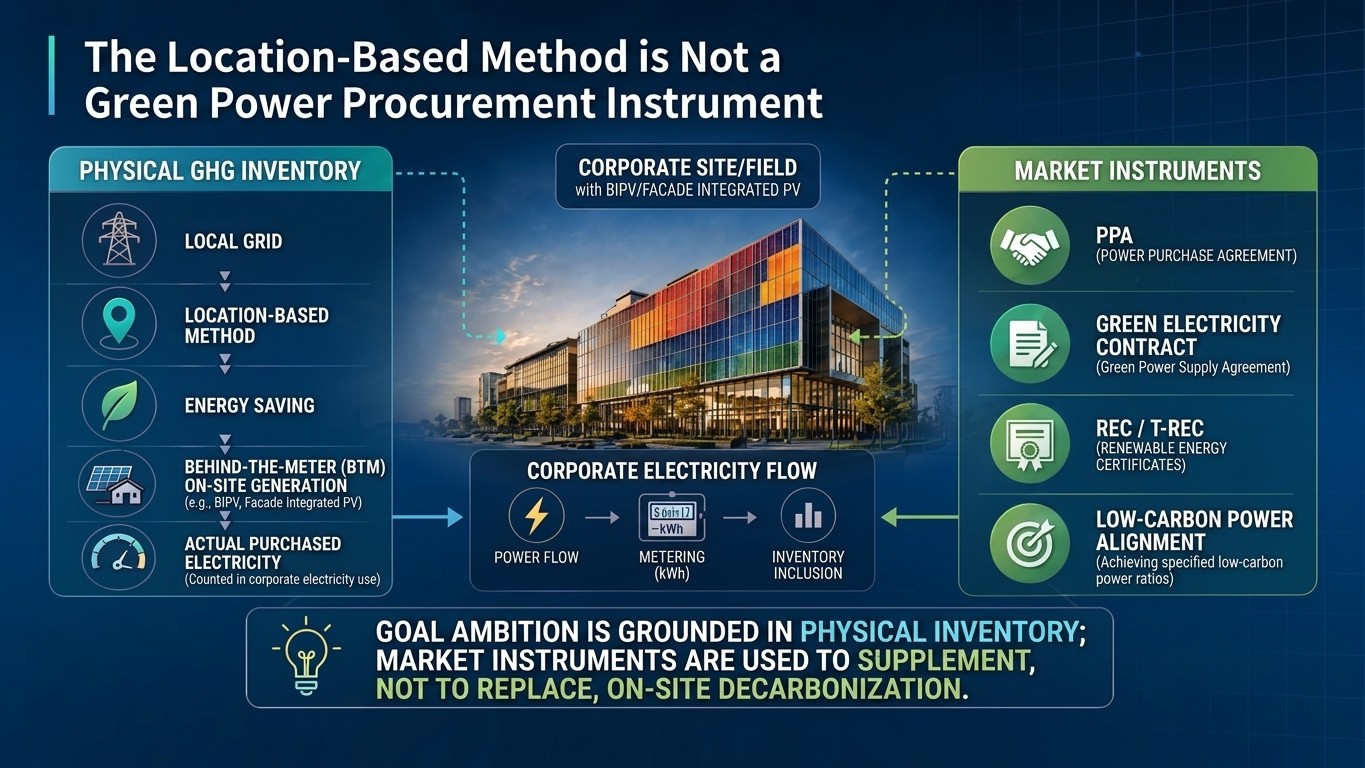
SBTi V2.0 continues to allow companies to pursue low-carbon electricity alignment targets or absolute Scope 2 emissions-reduction targets. PPAs, virtual PPAs and qualifying energy attribute certificates also remain implementation tools.
What has changed is that a low market-based emissions result can no longer, on its own, be treated as complete evidence that the company has transformed the physical electricity activity taking place at its location.
This brings Scope 2 back from being primarily a green electricity procurement issue and places it squarely within board-level decisions on capital allocation, operational management and risk governance.
Why corporate façades are entering Scope 2 decision-making
SBTi V2.0 places priority on activity-level decarbonisation actions, including reducing electricity consumption and increasing the physical consumption of low-carbon electricity generated behind the meter. Such electricity may come from on-site generation or from direct supply that does not pass through the public grid.
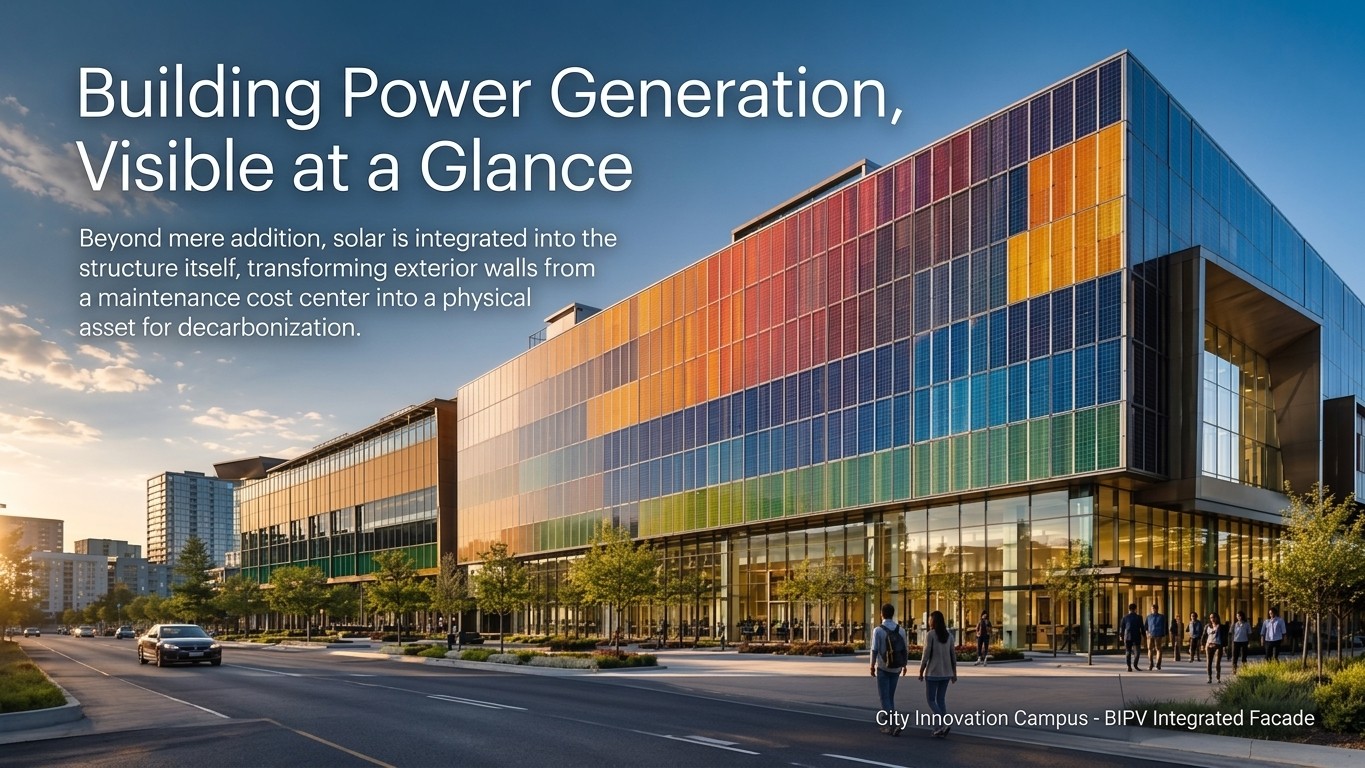
This is where building façade solar and corporate Scope 2 strategies intersect most directly.
When façade solar is installed at a company’s electricity-consuming premises, connected behind the meter and used for on-site self-consumption — with comprehensive records of generation, consumption, imports, exports and energy attributes — it ceases to be merely a corporate image project. It becomes an energy facility that directly changes the company’s electricity-use activity.
For internal corporate management purposes, the potential improvement in the controllable location-based inventory can initially be understood approximately as:
on-site electricity consumed in real time × the applicable grid emissions factor.
It is important, however, to emphasise that this is a management-estimation approach. It is not an SBTi-prescribed formula, nor should it automatically be equated with avoided emissions across the wider electricity system.
For companies, the most important question is therefore not how many kilowatts have been installed on the wall, nor how impressive the annual generation figure appears. What matters is how much of that electricity is actually consumed within the company’s electricity boundary and therefore reduces the amount of electricity purchased from the local grid.
Whether the system involves building-integrated photovoltaics, externally mounted façade modules or a retrofit solution for existing buildings, its ability to support corporate Scope 2 objectives depends on five governance conditions: the point of interconnection, organisational boundary, on-site self-consumption rate, ownership of energy attributes, and metering and third-party verification.
What companies therefore need to procure is not simply a photovoltaic module, but a decarbonisation evidence chain that can be used collectively by sustainability, finance, energy-management and building-engineering teams, as well as independent assurance providers.
Colour is not the carbon reduction — it is a deployment multiplier for façade generation
Colour itself does not constitute carbon reduction. But it can lower the acceptance barrier among architects, property owners, urban-design authorities and building users, turning previously difficult-to-develop vertical surfaces into viable areas for electricity generation.
Research by the IEA Photovoltaic Power Systems Programme (IEA PVPS) no longer treats building-integrated photovoltaics simply as equipment attached to a building. BIPV is examined as a multifunctional building component capable of performing both energy-generation and building-envelope functions. Its research also covers coloured BIPV, weather resistance and a wide range of technical and design considerations.
Copenhagen International School provides a representative international example. Its façade comprises around 12,000 solar panels covering approximately 6,048 square metres, making it one of Denmark’s largest building-integrated solar power installations.
What the project demonstrates is not that every building should replicate the same design. Rather, it shows that photovoltaics can move beyond the role of conventional mechanical and electrical equipment to become part of architectural design, brand identity and sustainability education.
Façade solar, however, is not a universal solution. Solar orientation, shading, fire safety, structural requirements, wind loading, glare, maintenance access, module replacement, degradation, insurance and building-envelope responsibilities must all be assessed in an integrated way before investment decisions are made.
This is also the positioning repeatedly emphasised by Richten Energy Co., Ltd. in promoting coloured solar façades: the objective is not simply to sell another solar panel, but to integrate architectural design, behind-the-meter connection, smart metering, self-consumption, energy attributes, operation and maintenance, and third-party verification into an energy asset that companies can actively manage.
When coloured solar façades are viewed purely as products, the discussion usually ends up focusing on price per kilowatt.
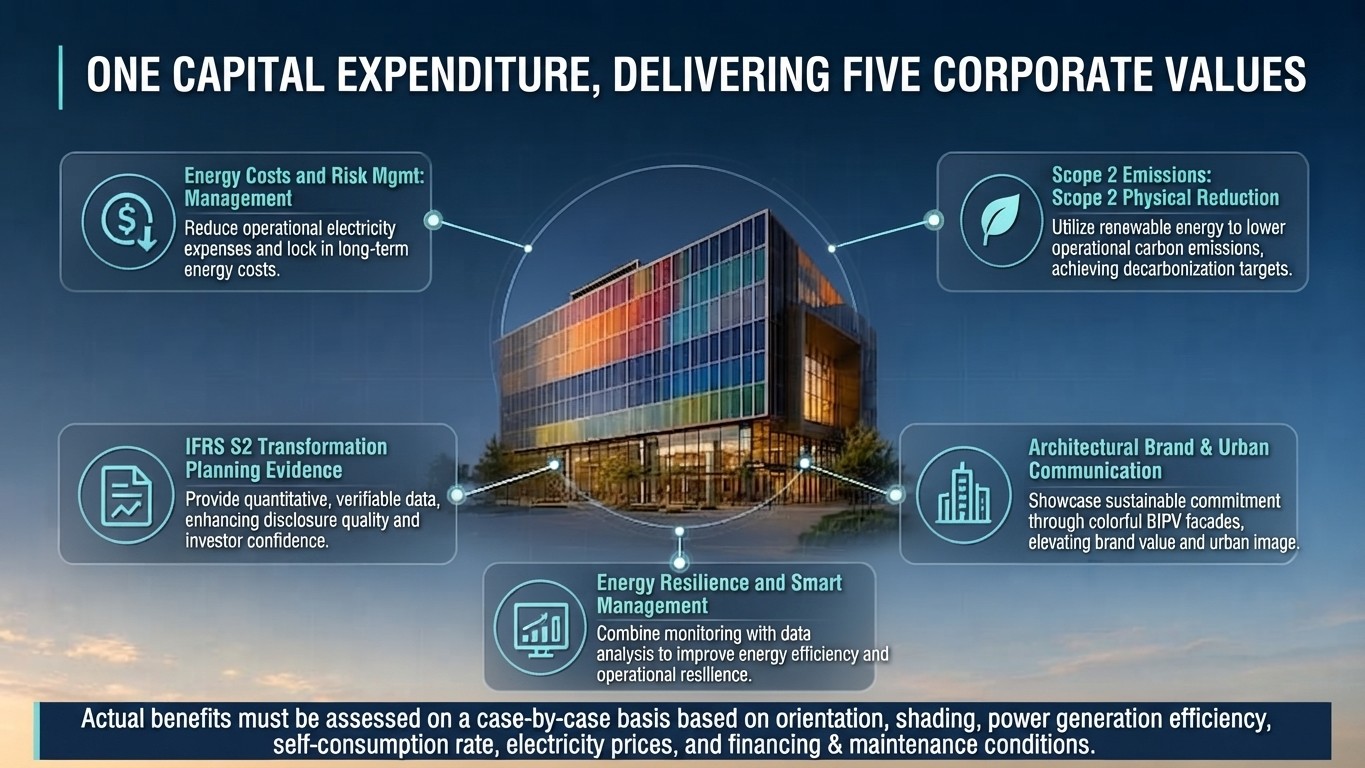
When they are incorporated into Scope 2 governance, building refurbishment and capital expenditure, the discussion shifts to cash flow, carbon-reduction outcomes, energy resilience and asset value.
Why CFOs, banks and accountants also need to pay attention
The EU’s European Sustainability Reporting Standards (ESRS) require companies to distinguish between location-based and market-based Scope 2 emissions and to provide information on relevant contractual instruments.
This means that maintaining two perspectives on Scope 2 is no longer merely a technical discussion among carbon-accounting specialists. It is increasingly embedded in formal disclosure frameworks.
IFRS S2 Climate-related Disclosures requires companies to disclose information on climate-related risks and opportunities that could reasonably be expected to affect their cash flows, access to finance or cost of capital over the short, medium or long term.
IFRS S2 does not require every company to produce a separate formal transition plan. But where a company has transition-related targets, strategies or approaches, material information relating to them may need to be disclosed.
Taiwan is phasing in the IFRS Sustainability Disclosure Standards from the 2026 financial year according to companies’ paid-in capital. In the first phase, listed companies with paid-in capital of NT$10 billion or more must compile sustainability information for the 2026 financial year and report it in 2027 alongside the relevant reporting cycle. The requirements will then be extended in stages in 2027 and 2028.
This means companies will increasingly need to answer more than simply: “How much renewable electricity have we bought?”
They will also need to answer:
How much capital has been committed to achieving the target?
Which assets are actually reducing demand for grid electricity?
How are generation, energy savings and self-consumption measured?
Does the company retain the relevant energy attributes, and have they been properly retired where required?
How do electricity prices, carbon costs, maintenance, insurance and financing conditions affect investment returns?
Can the underlying data withstand independent third-party assurance?
Banks will not finance a façade simply because it looks attractive. What financial institutions can assess are predictable cash flows, clearly defined rights, verifiable energy performance, and manageable engineering and operational risks.
The term “energy asset” in this article refers to the concept of capital allocation and operational management. It does not presume any particular accounting treatment. Whether an installation meets the accounting definition of an asset will still depend on matters including control, contractual structure, expected future economic benefits and the company’s accounting policies.
The next global trend: proving not only that renewable electricity was used, but when it was used
SBTi V2.0 has brought hourly matching into Scope 2 governance.
For relevant large electricity activity pools reaching the applicable annual electricity-consumption threshold, companies are required to calculate and report the proportion of low-carbon electricity that is matched to electricity consumption on an hourly basis. The final standard also establishes a voluntary recognition programme for higher levels of hourly matching.
The recognition thresholds are at least 50% until 2030, at least 75% until 2035, and at least 90% from 2035 onwards. These thresholds relate to voluntary leadership recognition rather than mandatory achievement targets for every company.
This means corporate energy management is gradually moving beyond annual volume balancing towards matching electricity by time and location.
Rooftop photovoltaic systems tend to concentrate generation during daytime hours. After hourly modelling, east- or west-facing façades may have the potential to extend the generation profile into the morning or afternoon. Combined with energy storage, energy management systems and demand response, this could improve the temporal alignment between corporate electricity loads and low-carbon electricity supply.
This outcome, however, cannot be assumed for every façade.
Companies must first validate it using hourly load profiles, orientation, shading and power-generation simulations, rather than relying solely on annual generation estimates or architectural renderings.
For data centres, hospitals, manufacturers and large commercial facilities, the next stage of value creation may therefore be less about “how much electricity is generated each year” and more about “how much low-carbon electricity can be supplied when the business needs it most”.
Taiwan’s policy is not wrong — it has simply completed only the first step
Taiwan’s Standards for the Installation of Solar Photovoltaic Power Generation Equipment in Buildings will take effect on 1 August 2026.
In principle, new buildings with a building area of at least 1,000 square metres, or qualifying additions or alterations involving roof or building areas of at least 1,000 square metres, must install photovoltaic capacity based on a requirement of 1 kW for every 20 square metres. This represents an important step forward in Taiwan’s building-energy policy.
The current system, however, remains centred primarily on building-area thresholds and minimum installed capacity.
The next stage needs to answer a broader set of questions: How can the full building surface be assessed? Is the electricity consumed on site? Does the generation profile match the building’s load? Who owns the associated energy attributes? And can the data be verified and incorporated into financial assessment?
The revised EU Energy Performance of Buildings Directive similarly requires Member States, where technically, economically and functionally feasible, to progressively promote or require appropriate solar installations on new buildings and certain existing public and non-residential buildings, supported by administrative, technical and financial frameworks.
International policy is therefore moving beyond asking simply whether solar should be installed. It is increasingly addressing existing buildings, public buildings, investment mechanisms and implementation conditions.
Taiwan’s Architecture and Building Research Institute (ABRI), Ministry of the Interior, has also used net-zero city exhibitions and related demonstration programmes to bring façade power generation into policy discussions and public-building validation.
The next stage of Taiwan’s building-solar policy could be strengthened through three concepts:
The first is “surface”.
Instead of assessing rooftops alone, authorities could extend mapping to rooftops, east-, west- and south-facing façades, carports, shading structures, noise barriers and other deployable building surfaces.
The second is “time”.
Policy could move beyond annual power generation towards hourly electricity loads, hourly generation, energy storage and demand response.
The third is “evidence”.
Smart metering, on-site self-consumption, grid imports and exports, energy attributes, operation and maintenance records and third-party assurance could all be incorporated into consistent data standards.
The government could go further by establishing a Public Building Vertical Power Generation and Scope 2 Evidence Chain Demonstration Programme, bringing together authorities responsible for the built environment, energy, financial supervision and local government alongside accounting and assurance professionals and industry.
Hospitals, schools, government offices, transport facilities and large public buildings could be prioritised as demonstration sites. Procurement assessments could also move beyond installed capacity alone to include self-consumption rates, generation availability, hourly matching, data integrity, O&M guarantees and whole-life benefits.
What Taiwan may need next is not necessarily another subsidy, but a common set of performance rules that enables government, businesses, banks, architects and assurance providers to speak the same language.
From renewable certificate allocation to measurable decarbonisation
A resilient Scope 2 strategy of the future will not depend on any single instrument.
Companies should first reduce unnecessary electricity consumption through energy efficiency. They can then increase behind-the-meter low-carbon electricity through rooftops, façades and other building surfaces; use PPAs and qualifying energy attribute certificates to address remaining scale and geographical gaps; and deploy energy storage, energy management systems and hourly data to improve the matching of electricity supply and demand.
Coloured solar façades are not intended to replace renewable energy certificates, PPAs or rooftop solar.
Rather, they add the vertical generation surface that many companies in high-density urban environments have long overlooked, together with a source of on-site energy capacity that businesses can manage directly.
Boards should now be asking three questions.
How much of the company’s Scope 2 target is grounded in the location-based method and the physical GHG inventory? And how much of the improvement comes from active corporate investment rather than simply waiting for the grid to decarbonise?
Has the company mapped its rooftops, façades, carports, shading structures and other building surfaces alongside its hourly electricity-load profile?
Has the company established a complete data chain covering generation, self-consumption, imports and exports, energy attributes, operation and maintenance, and third-party assurance?
What companies often lack is not a third renewable energy certificate, but the first roadmap capable of bringing buildings, energy, carbon emissions, finance and assurance into a single decision-making framework.
Once these elements are brought together, a corporate façade is no longer simply a building cost subject to annual depreciation and maintenance expenditure.
It has the potential to become a behind-the-meter energy asset that generates electricity, reduces carbon emissions, supports disclosure and carries the company’s brand commitments.
One final distinction remains essential: neither companies nor suppliers should claim that “coloured solar façades are SBTi-certified.”
SBTi validation relates to a company’s submitted science-based targets and their conformity with the relevant standard. It does not certify an individual product.
A more precise formulation would therefore be:
Coloured solar façades can serve as one form of behind-the-meter low-carbon electricity generation and activity-level electricity decarbonisation action that companies may deploy in pursuing Scope 2 targets under the SBTi Corporate Net-Zero Standard V2.0.
SBTi will begin accepting targets for validation under V2.0 from 1 February 2027, while V1.3.1 will remain available for new submissions until 31 January 2028. For businesses, this period should not be treated as a gap in which to wait for the full transition of the rules. It is a preparation period in which to begin adjusting capital allocation, energy data systems and building-asset governance.
Source: CNA Business Information Service
(The share action will open in a new window.)