CBAM Changes the Rules of the Game as Taiwan Races to Complete Its Energy Puzzle
Richten Energy 185
CNA Business Wire, 29 December 2025
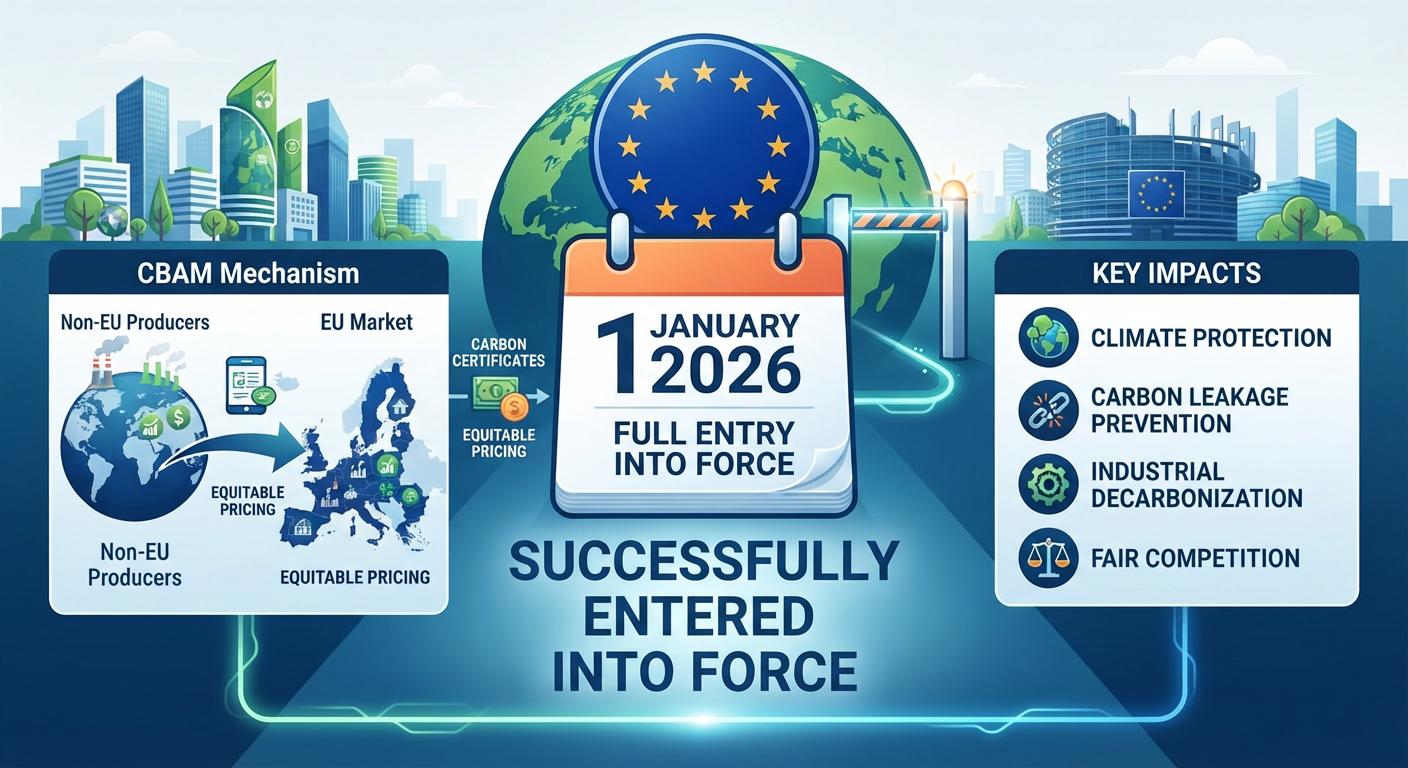
JOIN IT Sustainable Tech. CO., said the European Union’s Carbon Border Adjustment Mechanism (CBAM) is set to enter its definitive regime on 1 January 2026, marking an acceleration in the global supply chain’s shift from emissions reporting towards a new stage of compliance in which carbon emissions must be verifiable, traceable and subject to a price.
The company said the European Commission’s recently released C(2025) 8150 final and its annex, which establish a standardised template for verification reports, signal a fundamental shift in CBAM governance towards an evidence-based approach. Companies that lack auditable emissions data and adequate internal control procedures are likely to face higher compliance costs and greater uncertainty in cross-border trade. The measure was subsequently published as Commission Implementing Regulation (EU) 2025/2546 and applies from 1 January 2026.
Weili Hsueh, Founder of JOIN IT Sustainable Tech. CO., and Senior Strategic Adviser on Sustainable Development at the United Nations, said: “As the EU turns carbon into a regulatory language that is verifiable, traceable and subject to a price, the pressure on Taiwanese companies will rapidly become a dual challenge of carbon and electricity. Beyond the ability to measure and verify carbon emissions, access to green electricity will increasingly have a direct impact on order requirements, margin structures and decisions over where production lines are located.”
Hsueh added that Taiwan’s carbon fee regime took effect on 1 January 2025, with a standard rate of NT$300 per tonne of carbon dioxide equivalent and preferential rates available to companies implementing approved voluntary emissions-reduction plans. The introduction of the regime marks Taiwan’s formal entry into the era of carbon pricing.
However, without sufficient and scalable space for renewable-energy generation, businesses will continue to face competitiveness risks arising from shortages of green electricity.
A demonstration project at the Materials Testing Center of the Architecture and Building Research Institute, Ministry of the Interior (ABRI), has pioneered the application of a coloured solar façade on an existing public building. The project demonstrates a practical route to rapidly expanding the surface area available for renewable-energy generation without compromising the urban aesthetic, providing Taiwan with a tangible solution to the twin challenges of CBAM compliance and limited green-electricity supply. ABRI is Taiwan’s national building research agency under the Ministry of the Interior.
Against this backdrop, JOIN IT Sustainable Tech. CO., has proposed façade power generation as a practical way to rapidly expand the surface area available for renewable-energy generation. The company is promoting the use of building façades through its “recyclable application of colour-painted solar panel coating technology”.
The company said coloured solar technology can preserve the visual character of cities while reducing concerns over glare, combining electricity generation with thermal-insulation benefits to improve public acceptance and encourage adoption by local governments. Quantifiable data on electricity generation and carbon reductions can also support corporate ESG disclosures and supply-chain verification requirements, creating a solution that can be replicated and delivered at scale.
The surface coating of coloured solar panels can be customised with different textures and colours to complement architectural styles and the visual character of individual cities. By combining aesthetics and glare mitigation with electricity generation and thermal-insulation benefits, the technology can improve public acceptance and encourage local-government adoption, giving façade power generation the conditions needed to become a replicable and scalable policy solution.
JOIN IT Sustainable Tech. CO., called on Taiwan to accelerate the development of a coordinated “carbon and electricity” governance strategy in response to CBAM and changing global supply-chain requirements.
This would involve aligning Taiwan with internationally verifiable MRV — monitoring, reporting and verification — frameworks, while expanding the surface area available for renewable-energy generation through façade solar. The company said priority could be given to public buildings, schools and universities, healthcare facilities and transport noise barriers, creating an urban network of façade-based green-electricity generation that can first be demonstrated and then replicated more widely.
The European Commission adopted a series of implementing rules for the CBAM definitive regime in December 2025, including detailed requirements governing verification of embedded emissions. The rules establish requirements covering verification procedures, monitoring information, site visits, materiality and verification reports, marking a shift towards a system in which carbon data is increasingly subject to formal verification and traceability.
This regulatory shift is, in turn, forcing Taiwanese industries to confront the dual competitiveness challenge of carbon and electricity.
About JOIN IT Sustainable Tech. CO.,
JOIN IT Sustainable Tech. CO., focuses on net-zero buildings and façade-based renewable-energy solutions. The company develops recyclable coloured solar coating technology to help governments and businesses improve building energy efficiency and expand the surface area available for renewable-energy generation, while using quantifiable data to support ESG disclosures and the implementation of carbon-reduction targets.
Source: Central News Agency (CNA)
(The share action will open in a new window.)