Solar Panels Go Vertical, Carbon Reduction Now Quantifiable: A New Era for Urban Facades
Richten Energy 1
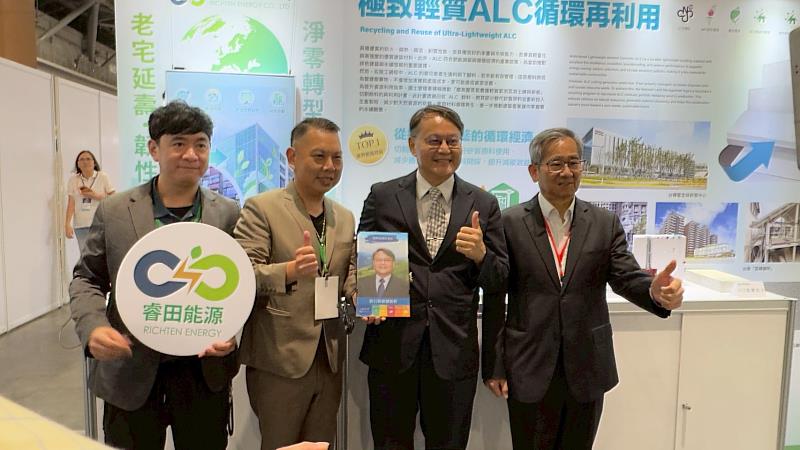
During the exhibition, Deputy Minister of Environment Yen-Ju Hsieh (second from right) visited the Ministry of the Interior’s exhibition area, where ABRI Director General Rong-jing Wang (first from right) and Richten Energy Chief Executive Officer Weili Hsueh (second from left) jointly introduced applications of coloured solar PV in building façades, net-zero transition and urban landscape integration.
They also held in-depth discussions on carbon-reduction methodologies for buildings and their importance to the development of a credible carbon credit system.
Rong-jing Wang, Director General of the Architecture and Building Research Institute (ABRI), Ministry of the Interior, said the building sector is a critical part of Taiwan’s pathway towards net-zero emissions by 2050. In addition to improving the energy efficiency of both new and existing buildings, future efforts will need to integrate renewable energy generation, operations and maintenance, material circularity and carbon-reduction data, enabling buildings to gradually shift from energy consumers to energy producers.
New Rules Take Effect in August: Both Rooftops and Façades Can Generate Power
The Standards for the Installation of Solar Photovoltaic Power Generation Equipment in Buildings, jointly issued by the Ministry of the Interior and the Ministry of Economic Affairs, will take effect on 1 August 2026. Under the new rules, newly constructed, extended or altered buildings with a building area of at least 1,000 square metres will, in principle, be required to install 1 kW of solar PV capacity for every 20 square metres.
According to policy estimates, the new rules could add approximately 660,000 kW, or 660 MW, of installed capacity each year, equivalent to the electricity demand of around 200,000 households. In future, building-mounted solar PV is expected to expand beyond rooftops to façades, shading structures, carports and public spaces.
Wang said the significance of building-mounted solar PV lies not simply in increasing installed capacity. Structural safety, weather resistance, building energy efficiency, equipment maintenance and module recycling must also be incorporated into whole-life building planning.
“Only when both rooftops and façades can become energy interfaces can buildings truly move from consuming energy to generating it. If a comprehensive mechanism for quantifying carbon reductions can be established, policy outcomes can move beyond simply ‘seeing the equipment’ to actually ‘measuring the emissions reductions’.”
ABRI said that as building-mounted solar PV enters a phase of large-scale deployment, the policy focus will move beyond simply ensuring that systems “can be installed” towards ensuring safe operation, long-term maintenance, proper handover and circular recycling, establishing a more comprehensive governance framework for building-mounted solar PV.
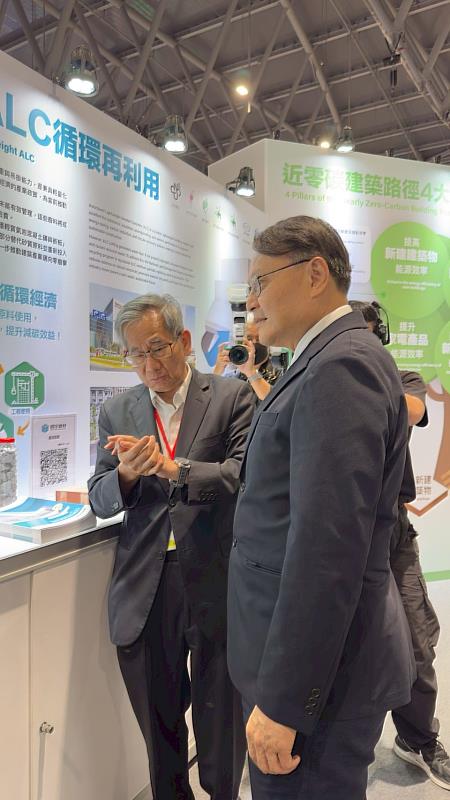
Cross-Ministerial Dialogue to Build Credible Carbon-Reduction Data for Buildings
During the exhibition, Deputy Minister of Environment Yen-Ju Hsieh visited the exhibition area and exchanged views with Wang and industry representatives on building energy efficiency, solar power generation, carbon-reduction methodologies and the carbon credit system.
ABRI said that what is commonly referred to as “building carbon credits” should, from a policy and regulatory perspective, be based on emissions reductions that are measurable, reportable and verifiable. Carbon-reduction benefits arising from building energy efficiency, renewable energy and equipment upgrades require clearly defined baselines, calculation boundaries, monitoring data and verification procedures before they can generate credible carbon credits.
Hsieh said:
“Credible, substantive emissions reductions are the prerequisite for carbon credits. If energy savings and solar power generation in buildings are to be converted into usable emissions reductions, a comprehensive methodology and a robust measurement, reporting and verification mechanism must first be established. This will allow building decarbonisation to move beyond engineering outcomes and become manageable and verifiable climate action.”
The Ministry of Environment has also continued to strengthen its policy tools for emissions reduction, bringing energy-saving measures, innovative carbon-reduction technologies and climate-adaptation research and development within the scope of government support programmes, while encouraging businesses, universities and research institutions to invest in technology development and field validation.
As Taiwan continues to advance carbon pricing, carbon credits and emissions trading, the building sector’s ability to establish credible carbon-reduction data will become an important foundation for future links between carbon management and green finance.
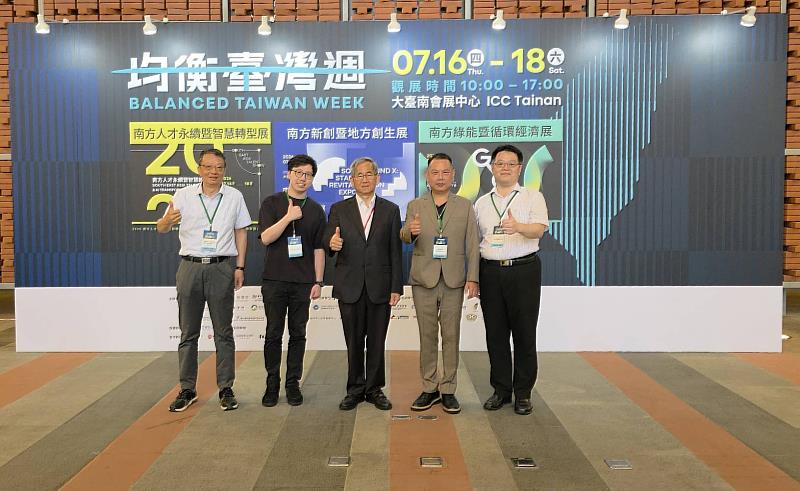
The Balanced Taiwan Week – 2026 Southern Taiwan Green Energy and Circular Economy Exhibition was held at ICC Tainan.
ABRI Director General Rong-jing Wang (centre) was joined by Richten Energy Chief Executive Officer Weili Hsueh (second from right), Jen-Te Chien of the Material and Chemical Research Laboratories, Industrial Technology Research Institute (ITRI) (first from left), ABRI Project Researcher Chun-Shen Liu (first from right), and Fang-Yuan Chuang, Engineer at the National Land Management Agency, Ministry of the Interior (second from left) for a group photograph, highlighting public-private collaboration in advancing near-zero-carbon buildings, building-mounted solar PV and innovation across Taiwan’s net-zero industries.
The exhibition also showcased a range of applications for building-mounted solar PV. Among them, Richten Energy Co., Ltd. presented its coloured solar façade technology, using imagery, colour and site-specific visual identity to integrate solar PV into building exteriors and the urban landscape while maintaining power-generation performance and meeting safety requirements.
At the 2026 Net Zero City Expo, ABRI had previously selected Richten Energy as one of the net-zero industry representatives exhibiting alongside the Institute. It noted that coloured solar modules can be incorporated into building façades to combine architectural aesthetics with energy efficiency, offering a new direction for the application of building-integrated solar PV.
Weili Hsueh, Chief Executive Officer of Richten Energy, said:
“Coloured solar PV is not about simply adding an image to a solar panel. It brings power generation, safety, architectural aesthetics, local culture, operations and maintenance, and carbon data together within a single system. We want every project to become a measurable, maintainable, verifiable and replicable demonstration, allowing policy to be translated into real applications across our cities.”
Hsueh said coloured solar PV could in future be deployed across public buildings, corporate headquarters, industrial facilities, campuses, social housing, transport hubs, parking facilities and tourism sites, enabling buildings not only to generate renewable electricity but also to express local identity, public character and corporate sustainability commitments.
The Public Sector Builds the Framework; Industry Delivers on the Ground
ABRI said the transition towards net-zero buildings is a systemic undertaking spanning regulatory frameworks, government ministries and professional disciplines.
The Ministry of the Interior is responsible for building standards, energy-efficiency policy, research and validation; the Ministry of Environment establishes carbon-reduction methodologies and carbon-management mechanisms; while industry must demonstrate, through completed projects, operational data and long-term maintenance, that innovative technologies can be successfully deployed in real-world settings.
The cross-ministerial and industry dialogue at the exhibition demonstrated how Taiwan’s net-zero policies are increasingly connecting building regulations and carbon-reduction methodologies with practical deployment in real-world environments.
The Ministry of the Interior said it would continue to advance near-zero-carbon buildings, building energy-efficiency improvements, the extension of ageing buildings’ service life and building-mounted solar PV through policy guidance, research and validation, demonstration projects and industry collaboration.
The ministry will also encourage industry to develop solutions that balance safety, energy, environmental performance, urban landscape and quality of life, contributing to Taiwan’s vision of achieving net-zero emissions by 2050.
The exhibition was held from 16 to 18 July at ICC Tainan (International Convention Center Tainan). The Ministry of the Interior’s exhibition area, located at Booth L134 on the first floor, showcased policy achievements and innovative applications in near-zero-carbon buildings, building-mounted solar PV, building energy efficiency, resource circularity and net-zero industries.
News source: Central News Agency (CNA)
(The share action will open in a new window.)