Heat Adaptation Emerges as New Climate-Tech Market as Richten Energy Targets Coloured Solar Façades and Net-Zero Building Assets
Richten Energy 109
 By Write News
Extreme heat is shifting from an environmental concern into a new risk for business operations, workplace safety and capital markets. Taiwan’s Ministry of Environment held a press conference for the 2026 Taiwan–Japan Alliance Against Extreme Heat – Cool Comfort Carnival today (4 August) at the National Science and Technology Museum in Kaohsiung. Through Taiwan–Japan collaboration, policy showcases, exchanges between government, industry and academia, and corporate technology applications, the event highlighted how heat adaptation is no longer solely an issue of public governance, but is also developing into a new market for climate technology and net-zero buildings.
From an economic and business perspective, the impact of extreme heat extends well beyond physical discomfort. It affects working efficiency, outdoor occupational safety, building energy consumption, peak air-conditioning demand, corporate ESG risks and property operating costs. As governments increasingly incorporate heat risks into cross-departmental governance, businesses are also facing a new investment question: how to reduce heat risks across their sites more efficiently while delivering energy savings, carbon reductions, stronger brand positioning and long-term asset value.
Minister of Environment Peng Chi-ming said effective heat governance requires both institutional frameworks and industry participation. Governments can establish early-warning systems, policy frameworks and demonstration projects in public spaces, but achieving impact at scale requires businesses, financial institutions, the construction sector, logistics operators, manufacturers and service industries to have solutions they can actually deploy.
Peng said climate adaptation should not be regarded merely as a cost, but as part of future industrial competitiveness. Companies that move earlier to manage heat risks will be better positioned to gain an advantage in the net-zero transition and sustainable governance.
Chen Yi-ting, Chairman of the Taiwan Association of Disaster Prevention Industry, said heat adaptation was emerging as a new growth market for the disaster-prevention industry. Whereas disaster management traditionally focused on post-disaster recovery, greater emphasis is now being placed on advance preparation and day-to-day risk management.
Chen said heat adaptation was creating an increasingly comprehensive industrial value chain encompassing sensors, early-warning systems, cooling equipment, workplace protection, building materials and energy management. By combining Japan’s institutional experience with field validation in Taiwan, the country’s disaster-prevention industry could develop solutions with export potential.
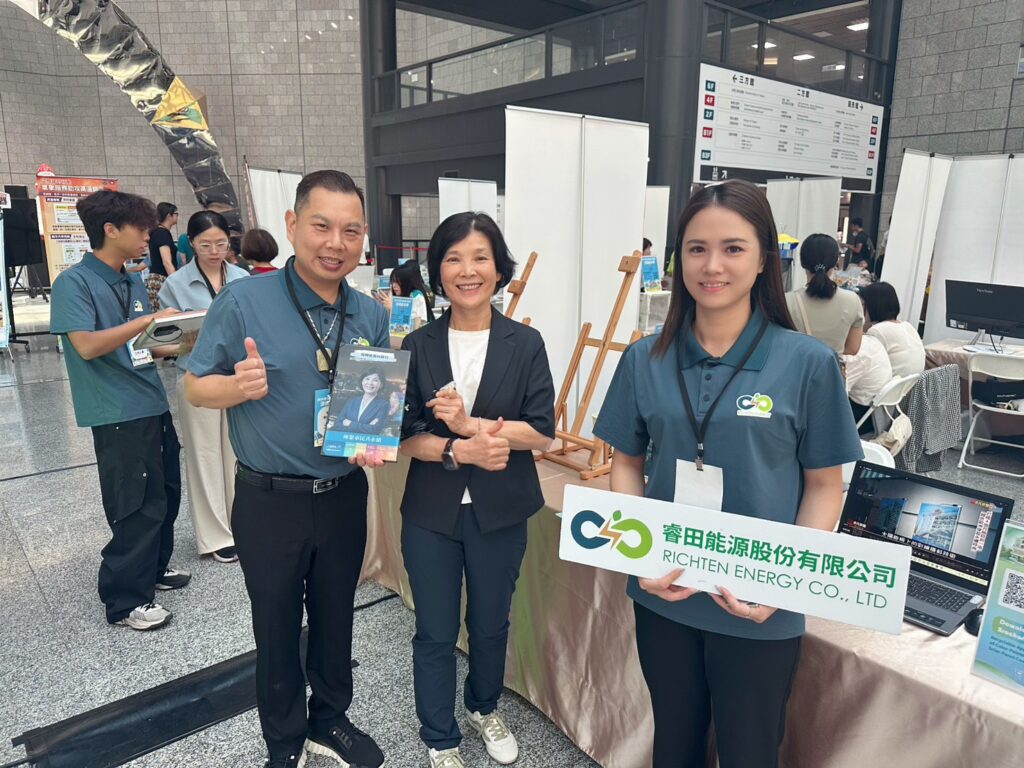
At the event, RICHTEN ENERGY CO., LTD. presented its coloured solar façade technology as an entry point into net-zero buildings and heat adaptation, advancing a commercial model centred on turning building façades into energy-generating assets.
Conventional solar installations are largely concentrated on rooftops, while the extensive façade areas of urban buildings remain an underutilised resource for both energy generation and cooling. By integrating aesthetically designed façade solar systems with shading, thermal insulation, power generation and carbon management, public buildings, schools, factories and offices, commercial buildings, logistics warehouses and large venues could be transformed from energy-consuming spaces into assets capable of generating electricity, being actively managed and demonstrating measurable ESG performance.
Weili Hsueh, Chief Executive Officer of Richten Energy, said the company’s future strategy would move beyond the sale of individual pieces of equipment. Instead, Richten plans to build replicable net-zero building solutions around four pillars: demonstration sites, data validation, carbon and energy management, and strategic partnerships.
Hsueh said corporate demand relating to ESG, carbon management and workplace safety was continuing to rise. If a building façade can simultaneously generate electricity, reduce heat, strengthen a company’s visual identity and provide carbon-reduction data, it should no longer be viewed simply as an engineering expense, but as a long-term operating asset.
“We want the market to understand that a wall capable of generating electricity is not simply a concept. It represents a new market in which future urban energy governance, corporate ESG strategies and green investment can all participate,” Hsueh said.
In its next phase, Richten Energy plans to explore collaboration in energy storage, smart energy management, low-carbon building materials, architectural design and ESG applications for large corporations. The company will prioritise demonstration projects in public buildings, schools, factories and offices, logistics warehouses and commercial buildings.
Measurable data covering electricity generation, cooling performance, carbon reductions and ESG impact will provide the basis for subsequent market expansion and strategic partnerships.
As the government incorporates heat adaptation into policy and governance frameworks, local authorities open up sites for deployment, and businesses face mounting energy and occupational-safety costs, climate technology is moving beyond the remit of corporate sustainability departments. It is increasingly becoming a commercial issue for boards, investors and industrial supply chains.
For Richten Energy, the Cool Comfort Carnival therefore represents more than an opportunity for visibility. It provides a strategic opportunity to position coloured solar façade technology within the broader markets for heat adaptation, urban resilience and net-zero buildings.

Source: Minsheng E-News
(The share action will open in a new window.)