Building Heat-Resilient Cities: Taiwan’s Central and Local Governments Join Japan in Advancing a New Model for Extreme-Heat Adaptation
Richten Energy 143
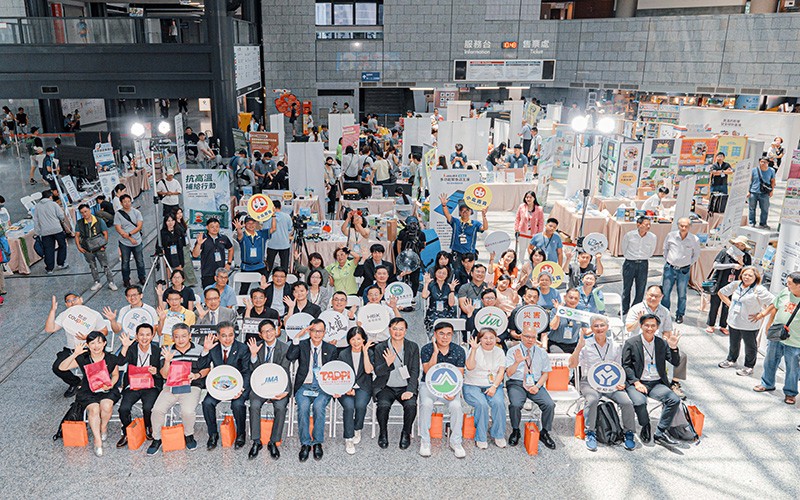
As extreme heat increasingly becomes the norm, it has emerged as a new challenge that both urban governance and everyday life must confront. Taiwan’s Ministry of Environment (MOENV) held a press conference for the “2026 Taiwan–Japan Alliance Against Extreme Heat – Cool & Comfortable Carnival” at the National Science and Technology Museum in Kaohsiung on the 4th.
Organised by the Ministry of Environment, implemented by the Taiwan Association of Disaster Prevention Industry, and co-organised by the Kaohsiung City Government and the National Science and Technology Museum, the event brought together government agencies from Taiwan and Japan, academics and experts, industry representatives and civil society organisations. It showcased tangible progress in bringing together central and local government, industry and international partners to advance adaptation to extreme heat.
Centred on making heat adaptation part of everyday life, industry and institutional governance, the event featured forums, demonstration projects, interactive experiences, Cool Map cooling locations, workplace heat-hazard protection, Cool Zones for logistics facilities, building-cooling applications and recognition for participating organisations.
Together, these initiatives seek to transform extreme-heat risk from an abstract climate issue into practical governance tools that the public can understand, businesses can adopt and local governments can implement. The event goes beyond conventional heat-safety awareness and represents an important demonstration of the Ministry of Environment’s efforts to translate climate-adaptation policy into practical action.
Minister of Environment Chi-Ming Peng said extreme heat was no longer simply a weather phenomenon, but a complex risk affecting public health, occupational safety, energy use, urban governance and social resilience. Climate adaptation, he said, cannot be limited to reminding people to drink more water and avoid excessive sun exposure when heatwaves arrive. Instead, Taiwan needs a sustainable adaptation system capable of operating across government departments and different types of environments.
By bringing together climate science, international experience, local governance and industrial technologies on a platform open to public participation, the event marks an important step in Taiwan’s transition from simply understanding the risks of extreme heat to developing the capacity to manage them. The Ministry of Environment’s official English materials identify Peng as Minister of Environment.
Ken-Mu Chang, Deputy Director-General of the Climate Change Administration, Ministry of Environment, said extreme heat was one of the climate risks most directly experienced in people’s daily lives and should be among the highest priorities for local governments implementing adaptation measures.
Future heat-adaptation strategies, he said, must integrate meteorological information, health risks, the urban environment, social welfare and care services, occupational safety and industrial innovation. The aim is to establish a policy cycle capable of providing early warnings, supporting emergency responses, tracking outcomes and enabling continuous improvement.
The Climate Change Administration will continue to help local governments strengthen risk identification, data applications and cross-departmental collaboration, ensuring that central government policies translate into concrete action in communities, schools, workplaces and urban public spaces. The agency's official English name is Climate Change Administration, Ministry of Environment.
A major highlight of the press conference was the signing of a tripartite memorandum of understanding between Taiwan and Japan.
Witnessed by Minister of Environment Chi-Ming Peng, the MOU was signed by Yi-Ting Chen, Chairman of the Taiwan Association of Disaster Prevention Industry; Toshiyuki Sasaki of the Japan Management Association; and Yoshihiko Oishi, Chairman of the Shizuoka Promotion Association.
The agreement marks the establishment of a formal framework for Taiwan–Japan cooperation on extreme-heat adaptation, the disaster-prevention industry, public education and demonstration projects. The Taiwan Association of Disaster Prevention Industry lists Chen as its current chairman for the 2025–2028 term.
The agreement goes beyond exchanges associated with a single event. It represents an upgrade in Taiwan–Japan cooperation on extreme heat, from one-off demonstrations to a platform designed to support sustained collaboration.
The three parties will focus on extreme-heat risk governance, promoting the exchange of adaptation knowledge, industrial technology matchmaking, development of demonstration sites, education and training, and the introduction of international case studies. Cooperation will gradually expand into areas including heat-injury early-warning systems, workplace protection, urban cooling, Cool Zone planning, building energy efficiency and disaster-prevention education.
Through the MOU, Taiwan aims to build a portfolio of heat-adaptation models that are replicable, verifiable and scalable, enabling policy outcomes to move beyond individual demonstration sites and become part of wider urban governance networks.
Yi-Ting Chen, Chairman of the Taiwan Association of Disaster Prevention Industry, said that in the era of climate change, extreme heat represented a new category of risk that was “chronic yet highly disruptive”.
As the implementing organisation for the event, the association’s role is to connect government policy, scientific research, corporate solutions and public needs. The objective is to ensure that heat adaptation moves beyond advocacy and becomes a set of public services and industrial applications that can be implemented, maintained and managed in practice.
The event also showcased the innovative capacity of Taiwanese businesses participating in climate adaptation.
Richten Energy Co., Ltd. presented its coloured solar façade technology and net-zero building applications, approaching the challenge of urban heat through the building envelope. Its solution combines solar shading and thermal reduction with renewable-energy generation, carbon reduction, urban aesthetics and carbon management.
Rather than relying solely on air conditioning as an end-of-pipe cooling measure, incorporating renewable-energy generation and passive cooling design into building façades could allow façades to become an important part of the infrastructure cities use to adapt to extreme heat.
Weili Hsueh, Chief Executive Officer of Richten Energy, said adapting to extreme heat could not depend solely on air conditioning or any single product. Solutions instead need to be designed around the combined requirements of cities, buildings, individual sites and the people who use them.
Richten aims to address the critical building-scale component of this challenge, transforming exterior walls from passive surfaces associated with energy consumption into urban energy assets capable of delivering power generation, cooling, aesthetics and carbon-management value.
The company plans to continue working with government agencies, the building industry, corporate ESG teams and operators of public facilities to advance replicable and scalable net-zero building adaptation solutions.
The “2026 Taiwan–Japan Alliance Against Extreme Heat – Cool & Comfortable Carnival” was more than an exhibition. It represented a practical exercise in translating policy into action and integrating different levels of governance.
Led by the Ministry of Environment, co-organised by the Kaohsiung City Government and the National Science and Technology Museum, implemented by the Taiwan Association of Disaster Prevention Industry, and supported by participants from government, industry, academia and civil society in both Taiwan and Japan, the initiative brought extreme-heat adaptation out of policy documents and into people’s daily lives, industrial environments and urban governance.
For Kaohsiung, the initiative provides an important demonstration of urban resilience in practice. For Taiwan, it represents a starting point for concrete action as the country confronts increasingly extreme climate conditions and works towards a low-carbon, liveable and climate-resilient future.

Source: China Times Electronic Newspaper
(The share action will open in a new window.)