Greenpeace Joins Civil Society Groups and Industry in Calling for Amendments to the Statute for Industrial Innovation to Support On-Site Renewable Energy Generation and Energy Storage
Richten Energy 46
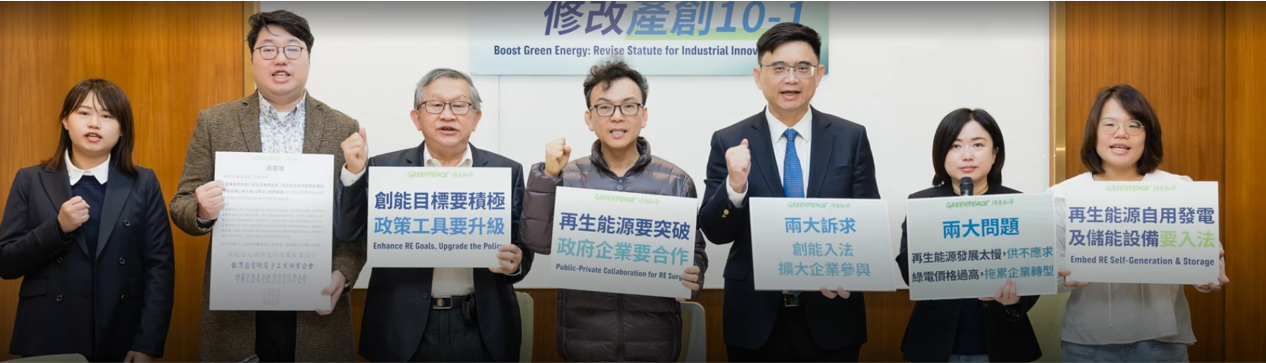
In response to rising electricity demand driven by the rapid growth of high-tech industries such as semiconductors and artificial intelligence, and to accelerate businesses’ transition to renewable electricity while maintaining industrial competitiveness, Greenpeace on 18 December joined legislators Lai Jui-Lung and Cheng Cheng-Chien, the Taiwan Renewable Energy Alliance, the Mom Loves Taiwan Association and representatives from industry at a press conference calling for amendments to the Statute for Industrial Innovation.
The groups urged the Ministry of Economic Affairs (MOEA) to revise the proposed amendment to Article 10-1 of the Statute for Industrial Innovation to include on-site renewable energy generation and energy storage equipment within the scope of incentives under the Act. They said the change would encourage more businesses to become renewable energy prosumers and participate in the renewable energy market, enabling the public and private sectors to work together to accelerate the development of renewable energy in Taiwan.
Greenpeace Climate and Energy Campaigner Hsin Yi said: “In October, the Ministry of Economic Affairs announced draft amendments to the Statute for Industrial Innovation, adding artificial intelligence, energy conservation and carbon reduction as eligible categories for investment tax credits under Article 10-1. Greenpeace welcomes the government’s decision to include energy and carbon reduction measures within the scope of investment tax credits.
“However, Taiwan still faces a number of energy challenges, including insufficient supplies and high prices of renewable electricity. The urgency of expanding renewable energy generation cannot be overlooked. We call on the government to use comprehensive policy tools to encourage businesses to voluntarily invest in on-site renewable energy generation and energy storage facilities, lowering the barriers to corporate investment in renewable electricity and enabling the public and private sectors to work together towards Taiwan’s net-zero transition.”
Legislator Lai Jui-Lung said: “Some provisions of the Statute for Industrial Innovation are due to expire at the end of the year, making these amendments urgent. The proposal put forward by Chen Su-yueh, Puma Shen and myself would make corporate investment in artificial intelligence, energy conservation and carbon reduction eligible for incentives, helping to encourage more businesses to invest in energy efficiency and carbon reduction.
“The demands raised by these groups could also be addressed through motions or resolutions during the amendment process. If the Executive Yuan is unable to submit its proposal in time, legislators’ proposals could be reviewed first. I hope the ruling and opposition parties can work together to pass this legislation through its third reading during the current legislative session, as it would benefit both the country and the public.”
Legislator Cheng Cheng-Chien said: “Hsinchu City has a strong manufacturing base, with manufacturing accounting for 61% of the city’s business turnover, making the sector highly dependent on a stable electricity supply. As the world places increasing emphasis on carbon reduction and the use of renewable electricity, Hsinchu City needs to accelerate the development of renewable energy.
“Energy storage can effectively address the intermittency of renewable power generation while increasing the share of renewable electricity. To support manufacturing and the energy transition, I will propose amendments to the Statute for Industrial Innovation to encourage businesses, through tax incentives, to invest in renewable energy generation and energy storage equipment, thereby advancing Taiwan’s green transition.”
Tsai Chih-Hung, a director of the Taiwan Renewable Energy Alliance, said: “On-site renewable energy generation equipment can help industries reduce carbon emissions and enhance their competitiveness while supporting the country’s energy transition. Energy storage equipment can also reduce the risk of power outages and help ensure a stable electricity supply.”
Huang Pin-Han, Senior Project Manager at the Mom Loves Taiwan Association, said: “Under the Climate Change Response Act, government ministries are required to submit draft Phase 3 periodic regulatory goals by the end of this year, together with greenhouse gas reduction action programmes for individual sectors covering 2026 to 2030.
“The Executive Yuan has also convened inter-ministerial working meetings and asked government agencies to review regulatory adjustments and policy instruments in line with carbon reduction targets. Applicants under the Statute for Industrial Innovation include many of Taiwan’s traditional industries and small and medium-sized enterprises. Adding on-site generation and consumption of renewable electricity as an eligible tax-credit item would not only contribute to Taiwan’s national carbon reduction targets but also help businesses meet their demand for renewable electricity.”
Greenpeace has also launched a petition in support of the proposal, receiving backing from a number of major industry associations. The support reflects strong expectations within industry for policies encouraging businesses to generate and consume their own renewable electricity. The petition remains open, with more industry representatives expected to join.
Wang Yi-Kai, Executive Supervisor of the Renewable Energy Commerce Association of the Republic of China, said: “Taiwan’s national energy policy originally set a target for renewable energy to account for 20% of electricity generation by 2025. Without appropriate incentives, this target will continue to be delayed. In keeping with the legislative purpose of the Statute for Industrial Innovation, supporting on-site power generation and energy storage equipment can improve the industrial environment and enhance competitiveness. Our association supports this proposal.”
Businesses have long relied heavily on electricity generated from fossil fuels, causing irreversible environmental and social pollution. With international fossil fuel prices continuing to rise and carbon border measures being introduced worldwide, increasing the share of renewable electricity through on-site generation and consumption can contribute to the sustainable operation of both businesses and society.
Greenpeace Climate and Energy Campaigner Hsin Yi stressed: “Our goal is to provide appropriate incentives through legislative amendments to help businesses overcome barriers to entry and, in turn, accelerate the overall development of renewable energy in Taiwan.”
Greenpeace made the following recommendations:
Include renewable energy generation in the legislation:
The Ministry of Economic Affairs should amend Article 10-1 of the Statute for Industrial Innovation to make on-site renewable energy generation and energy storage equipment eligible for investment tax credits. Legislative amendments and other policy tools should be used to support corporate investment in renewable energy and related equipment. Generating and consuming renewable electricity on site would not only reduce businesses’ reliance on external energy supplies but also help Taiwanese companies strengthen their competitiveness in international supply chains through the energy transition.
Simplify the application process and broaden corporate participation:
The existing eligibility requirements, conditions and application procedures under the Statute for Industrial Innovation can be difficult for businesses to understand, creating barriers to applications. To encourage companies to invest in innovation and research, the government should simplify the application requirements and procedures and provide an integrated advisory service, making the system more accessible and encouraging broader business participation.
News source: Greenpeace Climate and Energy Team
Greenpeace Taiwan – original article
(The share action will open in a new window.)