Solar Technology Breakthrough: Next-Generation Solar Cells Boost Efficiency by More Than 30% as Academia Sinica Advances Five Net-Zero “Arrows”
Richten Energy 69
Academia Sinica has brought together leading researchers from across Taiwan to form a next-generation solar cell research team, combining expertise in high-efficiency solar photovoltaic technologies from Academia Sinica, National Cheng Kung University, National Tsing Hua University and Ming Chi University of Technology.
Academia Sinica President James C. Liao said the research team had successfully developed a next-generation tandem perovskite/silicon solar cell with a light-to-electricity conversion efficiency exceeding 31% in just two years. This represents an improvement of more than 30% compared with the latest commercially available solar cells, and nearly 50% compared with earlier solar power installations.
The achievement not only demonstrates that Taiwan’s solar cell technology can compete at an international level, but could also support future upgrades to solar power installations, enabling greater electricity generation without increasing land use and bringing Taiwan closer to its net-zero emissions target.
Challenges and Breakthroughs in Solar Cell Technology
As the threat of climate change intensifies, the development of low- and zero-carbon clean energy has become a key global strategy for achieving net-zero emissions. With advantages including renewability, carbon-free electricity generation and the ability to produce energy domestically, solar power has become an important pillar of Taiwan’s energy transition.
Although Taiwan benefits from favourable solar irradiation, solar power installations require substantial areas of land, making it difficult to expand deployment significantly. Improving the light-to-electricity conversion efficiency of solar cells is therefore a key strategy for overcoming this constraint.
By increasing installed capacity and electricity generation per unit of area, technological innovation can reduce the amount of land required for solar deployment and ease the pressure created by growing demand for solar power.
The highest conversion efficiency of commercially available silicon solar cells is currently around 22–24%. With the same technology, it is virtually impossible to exceed 30%, meaning future solar cell technologies will need to move towards multi-junction or tandem architectures.
Dr. Chih-Wei Chu, a researcher at Academia Sinica’s Research Center for Critical Issues, said that after President Liao set the research direction two years ago, researchers and academic experts from within and outside Academia Sinica were invited to form a team dedicated to developing tandem perovskite/silicon solar cell technology.
The aim, he said, was to use higher-efficiency solar cells to meet Taiwan’s growing demand for low-carbon energy.
Professor Tzu-Chien Wei of National Tsing Hua University’s Department of Chemical Engineering, who also holds a joint appointment with Academia Sinica’s Research Center for Critical Issues, said: “Perovskite solar cells are among the most closely watched next-generation solar technologies, offering advantages including abundant raw materials, low-cost processing equipment, high efficiency and recyclability.”
Perovskite thin films have a wide range of potential applications. They can be combined with silicon solar cells to create tandem perovskite/silicon cells, further increasing light-to-electricity conversion efficiency.
Next-Generation Solar Cells Break Through the Efficiency Limits of Conventional Technology
Conventional silicon solar cell modules can absorb only part of the solar spectrum, limiting their conversion efficiency. In tandem solar cells, the upper perovskite layer absorbs photons that cannot be effectively captured by crystalline silicon, while the remaining photons are absorbed by the silicon layer beneath, increasing overall conversion efficiency.
The Academia Sinica research team achieved breakthroughs in several key interconnection-layer technologies, successfully stacking perovskite thin films onto silicon cells while reducing interface losses. The team produced small-area two-terminal solar cell devices with a maximum light-to-electricity conversion efficiency of 31.5%.
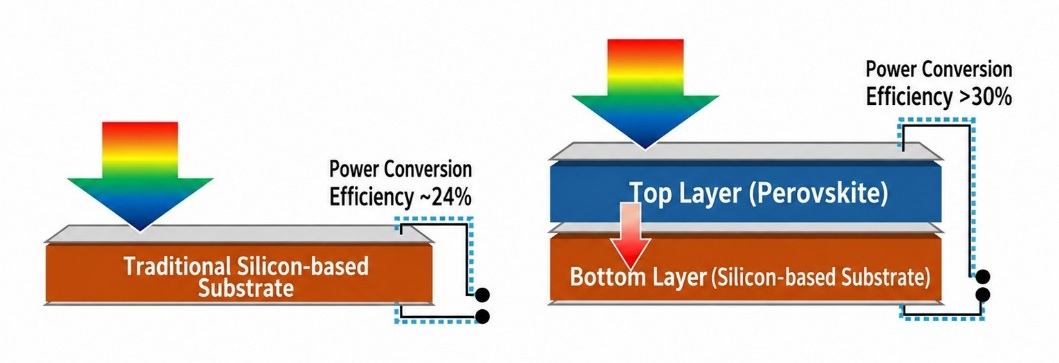
Illustration comparing electricity generation in conventional silicon and tandem solar cells. Image source: Academia Sinica.
Dr. Tzung-Fang Guo, a researcher at the Research Center for Critical Issues, said: “Although the current products are still small-area devices, this milestone demonstrates Taiwan’s capability in independent R&D and manufacturing of tandem solar cell technology. Our processes also show strong potential for commercial application.”
The research team will next focus on further optimising the manufacturing process, scaling up device sizes, improving the stability of tandem cells and developing manufacturing methods more suitable for mass production.
It will also continue to work closely with academic and research institutions and industry partners in Taiwan to advance the deployment of next-generation, high-efficiency solar power technologies.
Academia Sinica Continues to Advance Its Five Net-Zero “Arrows”
Academia Sinica has stepped up its research into innovative net-zero technologies in recent years. Its Five Net-Zero “Arrows” comprise Methane Pyrolysis to Power (MPTP), geothermal energy, marine energy, next-generation solar PV and biomass carbon sinks.
Dr. Chau-Hwang Lee, Director of Academia Sinica’s Research Center for Critical Issues, said the institute’s critical-issues research focuses on vertical integration from fundamental research through to real-world deployment, bringing together academic experts from across Taiwan while maintaining extensive dialogue with industry.
The objective, he said, is to ensure that practical applications are considered from the earliest stages of research and development.
With support from the Executive Yuan’s policy budget, Academia Sinica has established comprehensive tandem solar cell fabrication and measurement facilities at its Southern Taiwan campus in Gueiren District, Tainan, near the Tainan High-Speed Rail Station.
The facilities and equipment are also open for use by Taiwan’s industrial, academic and research communities, with the aim of bringing together research capabilities from different sectors and strengthening Taiwan’s global competitiveness in solar photovoltaic technology.
Academia Sinica will continue to build on its strong academic research foundations and combine the innovative capabilities of Taiwan’s academic and research institutions. By advancing all five of its Net-Zero “Arrows”, the institution aims to support Taiwan’s net-zero transition and contribute to a more sustainable future for society.
News source: Business Today
►Global Renewable Electricity Initiative RE100 Joining RE100 Marks a Key Step Towards Net-Zero Emissions for Companies Conducting Carbon Inventories ►Taiwan Smart Net-Zero Building Industry Alliance Officially Launched: Government, Industry, Academia and Research Join Forces to Advance 2050 Net-Zero Building Goal
(The share action will open in a new window.)