Maryland County Executive Returns to Taiwan for Net Zero City Expo, Sees Potential for Building Decarbonization Partnership
Richten Energy 128
A thin, lightweight panel — neither a desk mat nor a strip of advertising material — comes to life when exposed to the beam of a flashlight. The demonstration showcases a colored solar PV façade panel developed by a Taiwanese company, designed to carry customized graphics while generating electricity directly from building exteriors.
Compared with ground-mounted solar projects, which often face local opposition, and rooftop solar systems, which have yet to become widespread in many urban settings, industry players believe façade-based colored solar PV solutions could offer a more practical path for expanding renewable energy in cities.
“Our modules can also serve as advertising surfaces,” said Richten Energy Chief Executive Officer Hsueh Weili. “That means they can generate advertising revenue, support on-site power generation for self-consumption, and create additional value through the sale of renewable energy certificates. Together, these form three layers of a sustainable circular economy.”
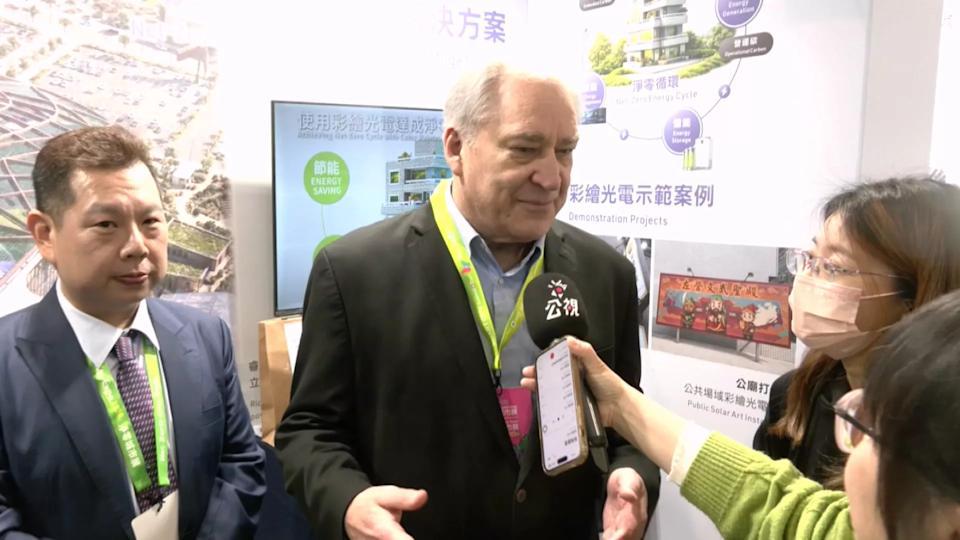
Marc Elrich, County Executive of Montgomery County, Maryland, who has visited Taiwan several times, returned to the Net Zero City Expo to explore potential applications of the technology in local buildings back home.
“This is truly a breakthrough,” Elrich said. “It can be installed in places where we normally would not think of putting solar. Anything that opens up more opportunities for solar energy is a good thing.”
Unlike conventional solar panels, which are often heavy and visually intrusive, colored solar PV façade panels are thinner, lighter, and more adaptable to existing buildings. They can be applied to exterior walls while reducing glare and improving visual integration with architectural design.
At the exhibition, other companies also presented exterior wall systems using dry-hanging construction methods. Instead of attaching tiles directly to a wall in the traditional way, the panels are mounted onto the façade, creating an air gap that helps with heat dissipation. Industry representatives said this approach can help reduce indoor temperatures by around 4°C to 5°C, depending on building conditions.
“The principle is thermal convection,” said Chiu Shun-nan, manager of the sustainable energy-saving division at a building materials company. “Heat rises, and by reducing the heat load on the main wall structure, we can further lower the indoor temperature.”
Energy-saving solutions for building exteriors are also attracting attention from the coatings industry. One paint manufacturer has developed sunlight-reflective coatings, which can be combined with thermal insulation materials and insulated glass to block at least half of incoming heat, according to the company.
Wang Wen-ting, chairman of the paint manufacturer, said promoting energy-efficient home appliances alone is not enough.
“Energy-saving appliances do help reduce electricity use,” Wang said. “But if you can block the heat at the source, that is where real energy efficiency begins.”
As Taiwan works toward net-zero emissions, carbon reduction efforts are expanding beyond factories and vehicles. The residential and commercial building sector also accounts for a significant share of energy use, mainly from lighting, air conditioning, and daily electricity demand, contributing roughly 20% of the country’s carbon emissions.
Taiwan’s Ministry of the Interior said it hopes more industries will bring low-carbon solutions into everyday living environments, including improving building energy performance and promoting low-carbon buildings as part of the country’s broader decarbonization strategy.
(The share action will open in a new window.)