Taiwan to Pilot Façade Solar PV on Five Public Buildings as Experts See Strong Potential in Northern Cities
Richten Energy 190
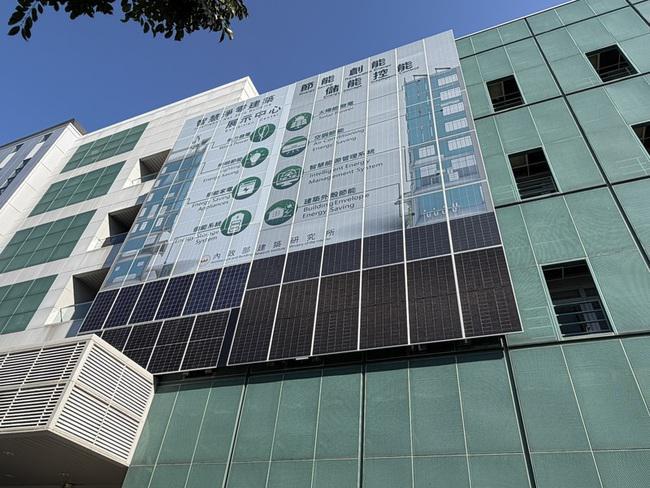
TAIPEI, May 20 — Taiwan is moving ahead with plans to promote solar PV on building façades, with five public buildings set to take the lead, including sites managed by the Architecture and Building Research Institute, Ministry of the Interior, and several public institutions.
Although façade-mounted solar PV generally produces less electricity than rooftop systems, experts say its larger available surface area could still make it a valuable source of renewable energy, particularly in dense urban areas in northern Taiwan. Industry representatives also believe that when colored solar PV is combined with customized visual designs, building façades can become advertising surfaces while generating electricity, creating multiple benefits for city residents and property owners.
The Ministry of the Interior has announced plans to promote solar PV applications on building façades. It is also studying ways to connect colored PV façade solutions with subsidies for extending the service life of older buildings, incentives for building-integrated renewable energy applications, and carbon credit mechanisms, with the aim of increasing the share of renewable energy generated by buildings themselves.
In addition to an existing demonstration project at the Architecture and Building Research Institute, the government is expected this year to provide further support for installations at the Ministry of Environment, National Taiwan University of Science and Technology, National Kaohsiung University of Science and Technology, and National Kaohsiung Normal University.
Lin Fu-ming, president of the Solar and New Energy Society of Taiwan and a division director at the Green Energy and Environment Research Laboratories of the Industrial Technology Research Institute, told CNA that Taiwan’s low-latitude location makes rooftop solar the most efficient option. Façade-mounted solar PV, he said, typically delivers around 50% to 60% of rooftop generation performance.
Even so, Lin said, façade solar can still make effective use of available sunlight, especially in central and southern Taiwan, where solar irradiation is stronger. Large installations can be placed on south-facing walls, west-facing walls exposed to afternoon sun, or unobstructed exterior surfaces. Windowless walls can also be prioritized to avoid affecting indoor daylight.
In northern metropolitan areas, Lin said, software analysis can be used to assess sunlight exposure and shading conditions to identify the best installation locations.
Lin said that, based on solar panel prices alone, installing one kilowatt of solar PV capacity — requiring about 4.3 square meters of surface area — costs slightly more than NT$60,000, which is somewhat lower than the cost of architectural stone cladding. Façade solar PV does not necessarily have to be paired with decorative modules, he added. A matte surface design can reduce glare while preserving stronger power-generation performance. As the most suitable rooftop spaces for solar PV gradually become saturated, incorporating façade solar PV or BIPV — building-integrated photovoltaics — could help improve overall renewable energy performance and support net-zero goals.
To test the benefits of façade solar PV, the exterior wall of the Smart Living Space Demonstration Center at the Architecture and Building Research Institute has been equipped with Taiwan’s first colored solar PV façade installation in two phases since late 2024.
Richten Energy Chief Executive Officer Hsueh Wei-li, whose company developed the colored solar PV coating technology used in the project, said the installation is expected to generate about 21,000 kilowatt-hours of electricity annually, reduce carbon emissions by 9.97 metric tons, and lower indoor temperatures by around 2°C to 3°C.
Hsueh said that as land becomes increasingly limited and rooftop solar approaches saturation, the façades of existing buildings can quickly provide additional surface area for renewable energy deployment. With colored solar PV technology, he said, exterior walls can also be transformed into advertising surfaces, while renewable energy certificates can create additional value through resale.
The result, Hsueh said, is a three-layer benefit: electricity generation, advertising revenue, and a circular-economy model.
Safety remains a key concern for façade-mounted solar systems. Civil engineer Wu Jui-lin, who was responsible for the engineering certification of the second phase of the Architecture and Building Research Institute’s façade solar project, said façade panels are exposed to a larger wind load than rooftop panels. Engineers must therefore assess the load-bearing capacity of exterior walls and the risk of panels falling during natural disasters.
Wu said engineers first evaluate whether the concrete strength of the existing building is sufficient, and contractors are advised to conduct pull-out tests before installation. In the design stage, he said, the spacing of steel support structures can be tightened, or additional bolts can be used, to improve wind and seismic resistance.
Because façade solar installation is similar in some respects to mounting large outdoor signs, Wu said waterproofing should be considered more carefully and comprehensively, particularly for older buildings.
The Energy Administration, Ministry of Economic Affairs, said simulation technologies show that façade-mounted solar PV can still achieve favorable sunlight exposure under suitable conditions. The agency said it will continue discussions with the Ministry of the Interior on appropriate locations and installation guidelines.
(The share action will open in a new window.)