Net-Zero Building Policies Take Effect as Together Sustainability and Richten Energy Move to Capture the Market
Richten Energy 381
Starting April 1 this year, real estate transactions involving existing buildings in Taiwan are required to disclose whether a property has obtained a building energy-efficiency label and whether solar PV equipment has been installed. From August 1, newly constructed, expanded, or renovated buildings with a floor area of 1,000 square meters or more will, in principle, be required to install 1 kW of solar PV capacity for every 20 square meters of building area.
As building energy performance becomes part of transaction transparency and regulatory compliance, net-zero buildings are moving beyond advocacy and entering a new stage defined by verification, disclosure, and recognized value.
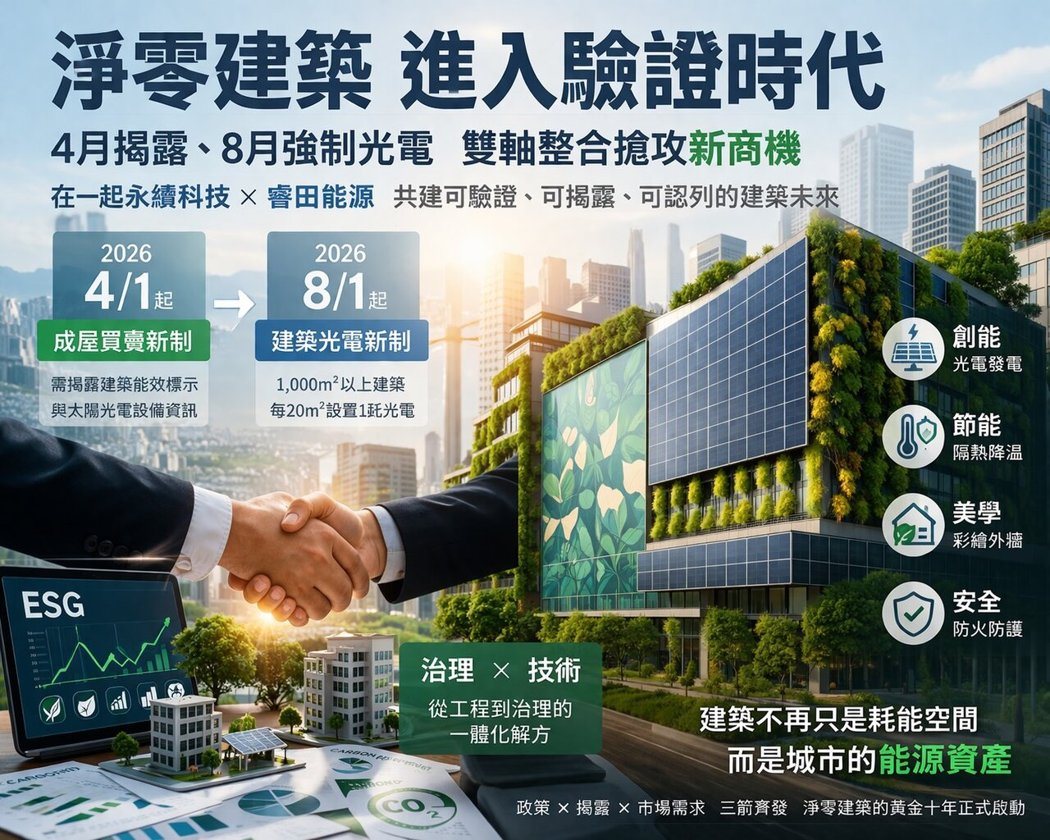
Photo caption:As net-zero building policies take effect, Together Sustainability Technology and Richten Energy are positioning themselves in the emerging market for building-based energy assets. Photo courtesy of Richten Energy.
These two policy milestones are also redefining the competitive landscape for Taiwan’s building industry. Once building energy performance becomes part of both transaction information and regulatory requirements, net-zero buildings are no longer simply a bonus feature. They are gradually becoming an important factor in how the market evaluates real estate assets.
More importantly, Taiwan’s Ministry of the Interior has planned to integrate building energy-efficiency information into the real estate transaction price inquiry system. In the future, when the public checks transaction prices, they will also be able to view a building’s energy-saving performance at the same time. In other words, a building’s energy efficiency and power-generation capability are shifting from technical engineering data into value indicators that the market can understand, compare, and recognize.
From the perspective of the capital markets, the IFRS Foundation’s IFRS S1 and IFRS S2 standards have been in effect since 2024. Companies are required to disclose sustainability and climate-related risks that could affect cash flow, access to financing, and the cost of capital. Going forward, carbon-reduction results that truly carry value will need to be more than technically achievable. They must also be understandable to investors, connected to corporate governance processes, and subject to external verification.
Against this backdrop, the collaboration between Together Sustainability Technology and Richten Energy is closely aligned with the key needs of the net-zero building market. According to publicly available company information, Together Sustainability Technology has obtained ANAB-accredited certification in the United States for greenhouse gas emissions under ISO 14064-1:2018 and ISO 14064-3:2019. Richten Energy, meanwhile, was shortlisted for the 22nd Global Views ESG Corporate Sustainability Awards in 2026 for its “Recyclable Colored Solar PV Façade Net-Zero Solution.”
Together Sustainability focuses on carbon inventory, carbon-reduction methodologies, and verification and disclosure mechanisms, while Richten Energy brings technical strengths in colored solar PV, solar façade applications, and building-integrated installation methods. Together, the two companies form a rare dual-engine model that combines governance capabilities with technology deployment.
This also means that future market competition will no longer be about who can install the largest amount of solar PV equipment. The real question will be who can integrate building construction methods, architectural aesthetics, carbon-reduction methodologies, and verification capabilities at the same time.
According to Taiwan’s official net-zero building roadmap, all new public buildings must achieve Building Energy Efficiency Class 1 or near-zero-carbon building standards by 2030. By 2040, 50% of existing buildings are expected to be upgraded, and by 2050, Taiwan aims for 100% of new buildings and more than 85% of all buildings to reach near-zero-carbon standards. Existing building upgrades, public buildings, campuses, and corporate headquarters are expected to become key sites for the next phase of net-zero building implementation.
Founder Wei-Li Hsueh said the competitiveness of future buildings will no longer depend only on location and construction cost. It will be reflected more directly in energy efficiency, carbon-reduction capacity, and verifiability.
“If a building only consumes energy, it will ultimately remain a cost,” Hsueh said. “But if it can generate power, save energy, and produce results that can be measured, verified, and disclosed, it has the potential to move from being a depreciating asset to becoming an energy asset.”
As the April disclosure rules and the August mandatory solar PV requirements take effect in sequence, the real business opportunities in net-zero buildings are becoming clearer. The key to future competition will not simply be who can deliver solar PV projects. It will be who can turn the idea of “buildings that generate power” into value that the market can understand and that capital markets are willing to recognize.
(The share action will open in a new window.)