World Engineering Day Spotlights Building Decarbonization as Richten Energy Advances Colored Solar PV Façade Solutions
Richten Energy 221
Richten Energy says sustainability must move beyond slogans and become an engineering system that can be delivered, verified and understood by the financial sector.
March 4 marks UNESCO’s World Engineering Day for Sustainable Development, an annual event that highlights the critical role of engineering in addressing climate change, urban transformation and industrial transition.
This year’s global theme focuses on “shaping a sustainable future through innovation and digitalization.” For Richten Energy Co., Ltd., the message is more direct: sustainability is not just a slogan. It must become an engineering system that can be delivered, verified and understood by financial institutions.
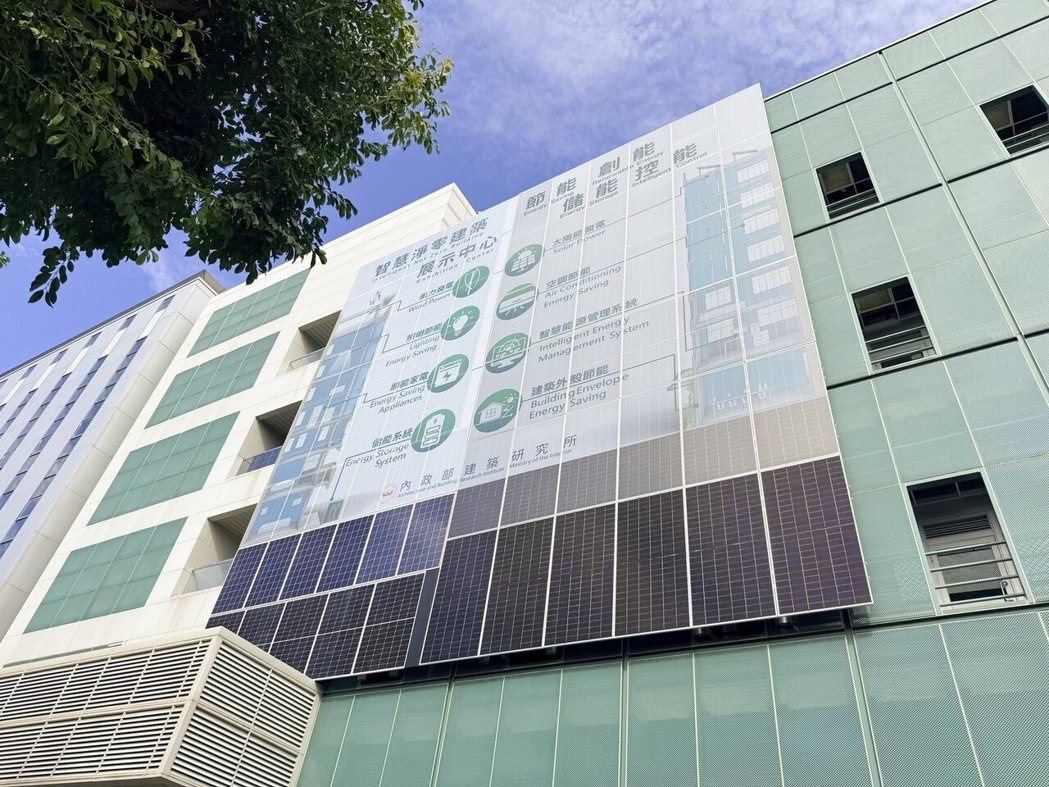
Photo: A colored solar PV demonstration façade at the Materials Experiment Center of the Architecture and Building Research Institute under Taiwan’s Ministry of the Interior. Some modules were made from retired solar PV modules that were tested, graded and remanufactured into colored solar PV façade materials, allowing the building envelope to generate electricity, reduce carbon emissions and enhance the urban landscape. The project demonstrates an engineering model for turning building surfaces into energy assets. Photo courtesy of Richten Energy.
Mandatory Solar PV Rules Put Existing Buildings at the Center of Urban Decarbonization
Taiwan’s renewable energy policy is entering a new stage. Starting August 1, 2026, newly built, expanded or renovated buildings with a building area of 1,000 square meters or more will, in principle, be required to install solar PV systems, except in certain exempted cases. The policy marks a shift for solar PV from an optional feature to a compliance requirement.
However, Richten Energy notes that if cities are to make real progress on decarbonization, they cannot rely only on the rooftops of new buildings. They must also address the much larger stock of existing buildings, especially older apartment blocks that require repairs, upgrades and life-extension work.
In recent years, Taiwan’s Ministry of the Interior has promoted policies to extend the service life and restore the functionality of older residential buildings. The program provides subsidies for buildings more than 30 years old to carry out façade repairs, pipeline replacement, roof waterproofing, elevator installation and accessibility improvements. Subsidies can reach up to NT$9.6 million per building, making the renewal of aging housing stock an increasingly important issue in urban governance
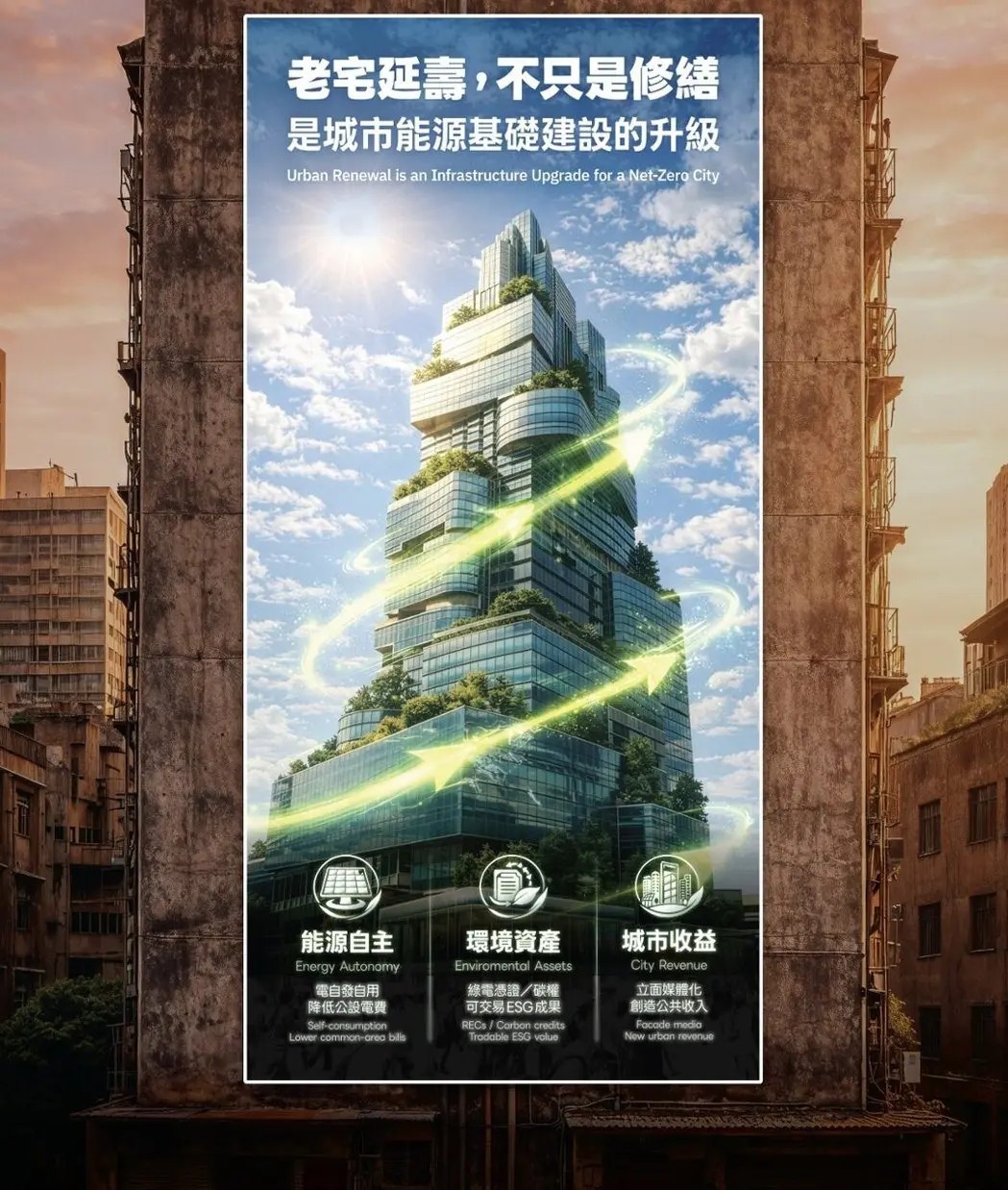 Photo: Concept image of a colored solar PV façade. Richten Energy turns building façades into renewable energy interfaces, allowing the renovation of older buildings to support power generation, carbon reduction and new sources of community revenue. Photo courtesy of Richten Energy.>
Three Major Barriers to Renovating Older Apartment Buildings
According to Richten Energy, older apartment buildings often face three major challenges when communities attempt to install elevators or renovate building façades.
First, many older apartment buildings lack a formal management committee, making it difficult to operate and maintain shared improvement projects over the long term.
Second, equipment such as elevators requires not only upfront construction costs, but also ongoing maintenance and electricity expenses.
Third, financing remains difficult. Residents need a predictable and verifiable source of cash flow to support long-term renovation work and loan repayment.
Colored Solar PV Façades: Turning Building Surfaces into Power-Generating Interfaces
To address these challenges, Richten Energy has proposed a circular colored solar PV façade solution that transforms building façades into scalable power-generating interfaces. Through modular design and data-driven management, the company aims to create a sustainable engineering system that can be delivered in real-world urban settings.
A Customizable and Replaceable Urban Façade
Colored solar PV is not simply about installing solar panels on a building. It is about turning the façade into a renewable and upgradeable urban interface.
The visual design can be customized to reflect a brand identity, public-interest message or community culture. The surface layer can also be replaced, helping reduce the visual depreciation that often comes with one-time installations.
Subject to regulatory compliance, the façade could also support corporate sponsorships or advertising partnerships, creating a potential public revenue source for residential communities. That income could then be used to help fund elevator maintenance, façade upkeep and other shared building expenses.
Façade-Based Solar PV Can Complement Rooftop Limitations
Compared with rooftops, which are often constrained by limited space, structural conditions and existing equipment, building façades provide an additional surface for solar power generation.
Taiwan’s Architecture and Building Research Institute has already introduced colored solar PV façades, energy storage equipment and a smart energy management system at its Materials Experiment Center as a demonstration project for the net-zero transformation of existing buildings.
Published materials from the institute also note that colored solar PV façades can expand the available area for power generation, reduce reflective glare and improve building appearance.
Giving Solar PV Modules a Second Life
The global solar industry is also facing the long-term challenge of retired PV modules. The U.S. Department of Energy has noted that the average lifespan of solar panels has increased from about 20 years in 2007 to roughly 25 to 35 years today. Many modules can still retain a certain level of performance at the end of their initial service life.
Richten Energy uses a process of testing, grading and remanufacturing to repurpose selected PV modules as façade materials. Through an energy management system, the company records power generation, operating performance and carbon-reduction results.
The company says its current demonstration project generates approximately 22,000 kWh of electricity per year and reduces carbon emissions by about 10.5 metric tons of CO₂e annually, with further applications being expanded.
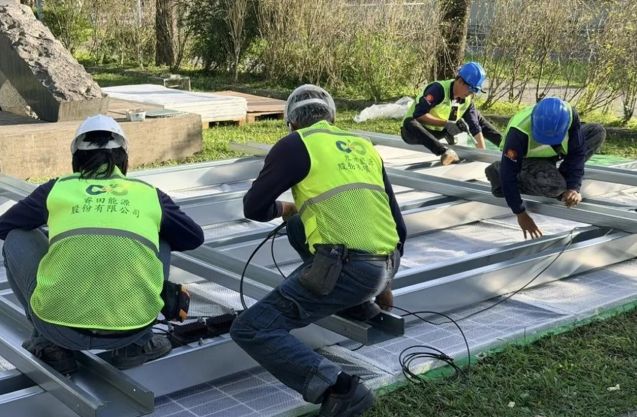
Photo:Richten Energy’s engineering team installs modular colored solar PV façade panels. Through a modular structure and colored surface-layer technology, the system allows existing building façades to incorporate solar PV without affecting the original building structure, offering a practical engineering solution for extending the life of older buildings and reducing urban carbon emissions. Photo courtesy of Richten Energy.
Turning Sustainable Engineering into a Financially Recognizable Asset
Richten Energy believes that accelerating the renewal of older buildings requires aligning engineering design with asset value.
On the engineering side, the system must be modular, replaceable and maintainable.
On the data side, power generation and carbon-reduction performance must be measurable.
On the financial side, electricity revenue and potential façade-related partnership income must form a predictable cash flow.
This model could help support long-term maintenance funds for residential communities and may eventually serve as a reference for financial institutions when assessing renovation financing.
Richten Energy CEO Hsueh Wei-li said World Engineering Day is a reminder that sustainability should not remain only a slogan.
“When a building façade can generate power, provide verifiable performance data, support circular use and produce cash flow that can be financially valued, the renewal of older buildings is no longer just an expense,” Hsueh said. “It becomes a long-term urban asset.”
(The share action will open in a new window.)