From Buildings to Learning Environments: Connecting Urban Energy and ESG
Richten Energy 207
Connecting urban energy and education through colored PV innovation
As cities worldwide accelerate toward net-zero targets, colored solar PV panels help transform buildings from passive energy consumers into active components of urban energy systems. At the 2026 Smart City Expo in Kaohsiung, Richten Energy and Join It Sustainable Tech presented their colored PV façade solutions, demonstrating how renewable energy can be integrated into building surfaces to enable energy generation, thermal performance, and architectural design.
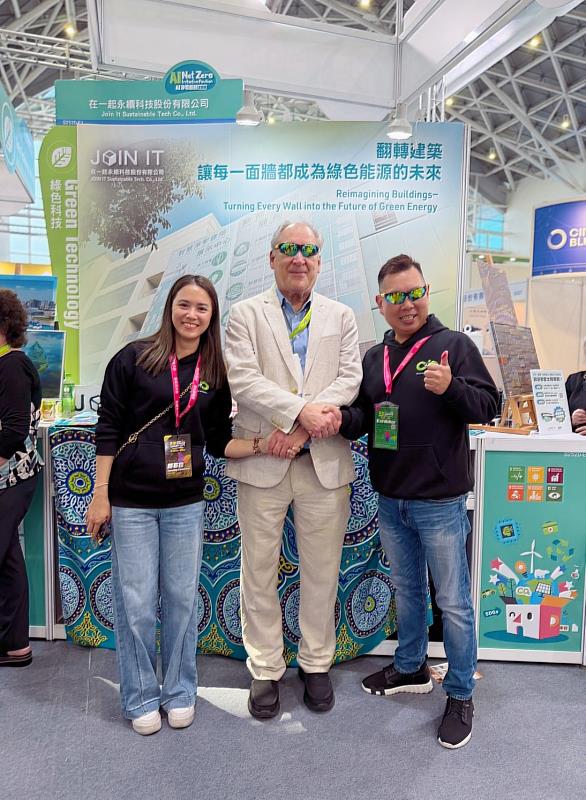
Montgomery County Executive Marc Elrich (center) visits the Richten Energy and Join It Sustainable Tech exhibition at the Kaohsiung Smart City Expo, meeting with Richten Energy General Manager Claire Lee (left) and CEO Weili Hsueh (right). He expressed strong interest in the potential of colored PV façade applications in urban and educational environments.
From observation to implementation
International interest in colored solar PV technology has reached a turning point. A U.S. municipal representative who has followed this development for several years visited Kaohsiung for high-level discussions, signaling a shift from long-term observation to practical evaluation and potential large-scale application.
This transition highlights a broader trend: façade-based solar solutions are moving from demonstration to real-world application in urban environments.
Rethinking the role of buildings
Beyond improving energy efficiency, our vision is to redefine the role of buildings in the 21st-century city. By integrating colored solar PV panels into façades, buildings can generate power while maintaining architectural aesthetics, transforming passive building surfaces into active components of the urban energy system.
This shift opens new possibilities for how cities approach sustainability, resilience, and design.
Bringing ESG into everyday environments
A key question emerging from our recent exchanges is how the next generation will live in, experience, and interact with sustainable cities.
In this context, educational environments become critical. Schools are increasingly expected to participate in energy and carbon management, yet many existing solar installations do not provide direct engagement or control at the institutional level.
Richten Energy’s colored PV façade approach offers an alternative:
Enabling localized energy generation and management
Creating visible and interactive learning environments
Integrating sustainability into daily campus experience
This allows ESG concepts to move beyond policy frameworks and become tangible and experiential.
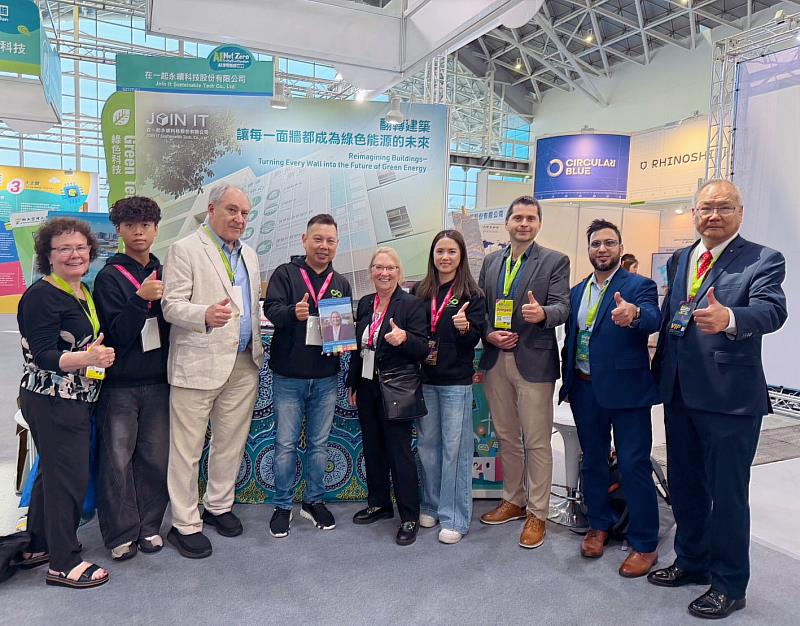
Montgomery County Executive Marc Elrich (third from left) leads a delegation to visit the Richten Energy and Join It Sustainable Tech exhibition at the Kaohsiung Smart City Expo. During the visit, Richten Energy CEO Weili Hsueh (center) presents a customized colored PV panel to Montgomery County Council Vice President Marilyn Balcombe (center right), symbolizing growing international collaboration in net-zero building technologies. The delegation also highlighted the potential of colored PV façade applications in cities and campuses.
From demonstration to scalable applications
Pilot applications in educational and public environments are beginning to take shape, where technology, policy, and community engagement intersect.
These developments illustrate how renewable energy solutions can support not only carbon reduction, but also education, awareness, and long-term behavioral change.
Toward the next phase of urban energy transition
As global cities continue to explore practical pathways to net-zero, the convergence of technology, real-world applications, and international collaboration is becoming increasingly important.
With growing interest from international stakeholders and expanding local demonstration projects, colored PV façade systems are approaching a critical stage—transitioning from innovation to scalable urban deployment.
(The share action will open in a new window.)