Can Solar Panels Coexist with Nature? Two Case Studies Show the Disruptive Potential of Ecovoltaics
Richten Energy 175
As the world confronts the dual challenges of climate change and rising energy demand, governments and industries are looking for ways to balance development with environmental protection. Recent reports from the International Energy Agency (IEA) point to a 4% increase in global electricity demand, driven in part by extreme heat waves that have increased the need for cooling.
In response, the United States is advancing a new wave of renewable energy development on federal lands, with growing interest in ecovoltaics and agrivoltaics. These emerging approaches aim to ensure that energy expansion does not come at the expense of the environment or agriculture.
Balancing Land Use and Environmental Protection
Historically, U.S. federal lands have been used primarily for grazing, mining, and fossil fuel extraction. Although renewable energy still accounts for only a small share of total energy capacity on these lands, research by the National Renewable Energy Laboratory (NREL) suggests that federal lands have enormous solar potential, with an estimated technical capacity of 1,750 GW.
Using high-resolution imagery and Geographic Information Systems (GIS), researchers have identified possible pathways for achieving 100% carbon-free electricity by 2035 while minimizing environmental impact. Notably, reaching that goal would require less than 0.5% of total federal land. Even so, that relatively small footprint still calls for innovative approaches, such as ecovoltaics, to reduce habitat loss and protect biodiversity.
The Aurora Solar Plant: A Case Study in Ecosystem Restoration
A landmark long-term study at the Aurora solar plant in Minnesota has given ecovoltaics a major boost. Researchers from NREL, Argonne National Laboratory, and several partner organizations found that native prairie ecosystems can be restored around, and even directly beneath, solar arrays.
The solar panels provide beneficial shade that helps improve soil conditions and allows vegetation to thrive. The study found that restored solar sites can support pollinator populations comparable to those found in dedicated nature reserves. These pollinators can, in turn, help improve crop yields on nearby farmland.
Although full ecosystem development takes several years, the findings show that solar infrastructure does not have to be a threat to biodiversity. Under the right conditions, it can become a catalyst for ecological restoration.
Sheep as the Ideal Solar Groundskeepers
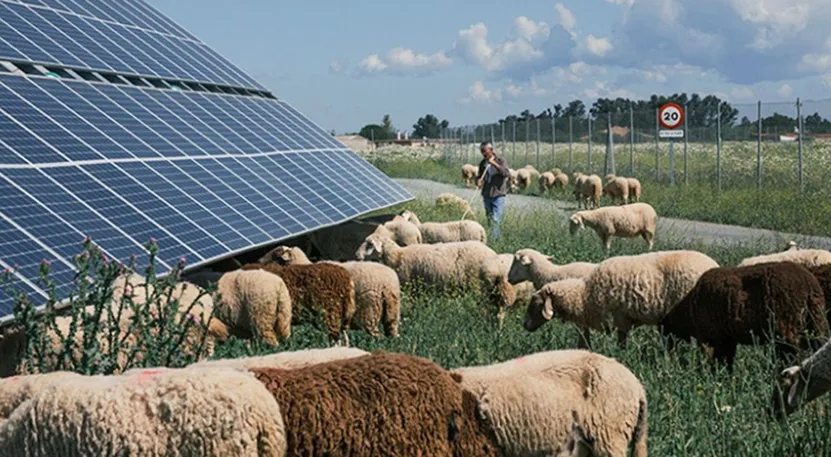
Beyond ecosystem restoration, agrivoltaics — the dual use of land for solar energy generation and agriculture — is also gaining momentum. Solar farms are typically built on sunny, flat land, which is often well suited for livestock grazing.
By replacing gas-powered mowing equipment with sheep, solar developers can reduce carbon emissions while also supporting the struggling American sheep and wool industry. In Texas, entrepreneurs such as JR Howard, founder of Texas Solar Sheep, have expanded their operations to thousands of animals. Their companies provide vegetation management services for solar farms while helping reduce the visual and environmental impact of large-scale solar projects in rural communities.
A Path Forward with Cautious Optimism
Early results from ecovoltaics and agrivoltaics are promising, but experts caution that many questions remain, particularly regarding long-term impacts on soil health and overall land productivity.
Current research suggests that dual-use land may not always outperform single-use land from a strictly industrial productivity standpoint. However, it offers a transformative framework for renewable energy development that is more closely aligned with community needs, agricultural practices, and environmental stewardship.
As these experiments continue, they offer a possible blueprint for a future in which clean energy, sustainable agriculture, and healthy ecosystems can coexist.
(The share action will open in a new window.)