Five Public Buildings Pioneer Vertical Solar PV Facades as Experts See Growth Potential in Northern Urban Areas
Richten Energy 30
Government Leads the Way with Pilot Projects
Taiwan’s government is stepping up efforts to promote vertical solar PV facades, beginning with pilot installations on five public buildings. The sites include the Architecture and Building Research Institute (ABRI), National Taiwan University of Science and Technology (NTUST), the Ministry of the Environment, National Kaohsiung University of Science and Technology (NKUST), and National Kaohsiung Normal University (NKNU).
The Ministry of the Interior is also drafting subsidy measures that would combine vertical solar PV installations with the renovation of aging buildings, BIPV integration, and carbon credit incentives. The goal is to increase energy self-sufficiency in urban buildings while supporting Taiwan’s broader transition toward net-zero cities.
Efficiency and Strategic Placement
Lin Fu-ming, Chairman of the Solar and New Energy Society of Taiwan (SNES/Taiwan) and Green Energy & Environment Research Laboratories (GEL), said that while vertical solar PV systems generally generate about 50% to 60% of the electricity produced by rooftop systems, building facades offer a much larger surface area for solar deployment.
In southern Taiwan, south-facing and west-facing facades are considered especially suitable. Even in dense northern urban areas, software-based analysis can help identify optimal installation points to maximize sunlight exposure and reduce the impact of shading.
Cost-Effectiveness and Aesthetics
With solar equipment costs now at approximately NT$60,000 per kilowatt, the price is slightly lower than that of traditional architectural stone cladding. Experts say modern matte finishes can help reduce glare without significantly compromising power generation efficiency.
As prime rooftop space becomes increasingly limited, using building facades for solar PV installation is emerging as an important strategy for advancing Taiwan’s net-zero emissions goals.
Case Study: The ABRI Demonstration Site
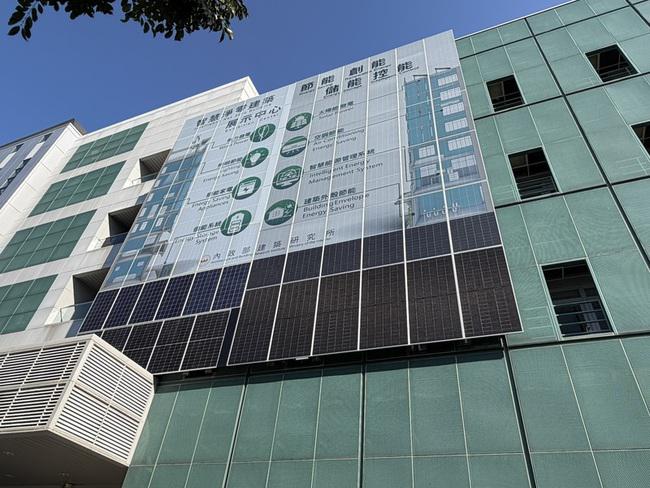
The ABRI’s Intelligent Living Space Display Center features Taiwan’s first large-scale colored vertical solar PV facade.
Hsueh Wei-li, CEO of Richten Energy, the company behind the colored solar PV layering technology, estimates that the project will generate 21,000 kWh of electricity annually, reduce carbon emissions by nearly 10 metric tons, and lower indoor temperatures by 2 to 3 degrees Celsius.
Triple Benefits: Power Generation, Advertising, and the Circular Economy
Hsueh said vertical solar PV panels can also function as “digital billboards” or “artistic walls.” This gives building owners access to three potential sources of value: generating clean electricity, earning advertising revenue, and participating in the circular economy through the sale of renewable energy certificates (RECs).
Safety and Structural Integrity
Civil engineer Wu Rui-lin emphasized that vertical installations are exposed to higher wind loads than rooftop systems. Safety, he said, must therefore be a top priority. Projects should undergo rigorous assessments of concrete strength as well as pull-out tests before installation.
Wu also recommended increasing the density of steel supports and adding more bolt fixings to ensure that the panels can withstand typhoons and earthquakes. He said the safety standards should be comparable to those required for large commercial signage.
Future Outlook
The Ministry of Economic Affairs’ Energy Administration said simulation results show that vertical solar PV systems can achieve strong light absorption under the right conditions. The agency said it will continue working with the Ministry of the Interior to refine installation regulations and identify suitable urban areas for future expansion.
(The share action will open in a new window.)